How to Recover From Bad Reviews: A 3-Phase Reputation Repair Plan (With Scripts)
March 24, 2026
 Rebecca Stone· Online Reputation Consultant
If your business just got hit with bad reviews, here’s the truth: respond quickly, fix what’s broken, and actively generate new positive reviews to rebuild trust and your star rating.That’s the real strategy for how businesses can recover from bad reviews.
To better understand how much impact each review has on your rating, you can try a review rating calculator and estimate how quickly you can recover.
But you have to do it properly,in a way that improves your visibility, conversions, and long-term credibility,and requires a structured and consistent approach.
Let’s walk through it like we would if we were fixing your business together over coffee.
Why Online Reputation Management Directly Impacts Your Bottom Line
Bad reviews don’t just sit there looking ugly,they actively influence buying decisions and revenue.
According to industry research:
-
Around 93% of consumers read online reviews before making a purchase
-
Nearly 49% trust reviews as much as personal recommendations
-
Businesses risk losing up to 22% of potential customers with just one negative review
Now connect that to your average star rating.
If your rating drops from 4.6 to 3.9, your listing becomes less attractive instantly. Your click-through rate drops, fewer people visit your website, and your conversion rate takes a hit.
This is exactly why online reputation management (ORM) is not just a marketing task,it’s revenue protection.
Google’s local search algorithm reinforces this by prioritizing:
-
Fresh reviews
-
Consistent responses
-
Overall sentiment
Every review you ignore works against both your visibility and your credibility.
The Anatomy of Negative Feedback: Identifying the 4 Types of Bad Reviews
Not all bad reviews should be handled the same way. Recognizing the type of review is the first step toward an effective response strategy.
1. Legitimate Customer Complaints (Constructive Criticism)
These are the most valuable reviews you’ll get because they reveal real issues.
They typically:
-
Mention specific details
-
Describe what went wrong
-
Reflect genuine dissatisfaction
Example:
“Delivery was 45 minutes late and no one answered the phone.”
That’s actionable feedback.
Businesses that actively use customer feedback can improve retention rates by up to 25%.
What to do: Acknowledge, apologize, and fix the issue internally.
2. Emotional or One-Off Negative Experiences
These reviews are driven more by frustration than facts.
They tend to be:
-
Vague
-
Short
-
Emotionally charged
Example:
“Terrible service. Never coming back.”
What to do: Stay calm, professional, and invite the customer to continue the conversation privately.
Even if they never respond, your reply builds trust with future customers.
3. Fake, Spam, or Malicious Reviews
These are often:
-
From suspicious profiles
-
Generic or repeated
-
Unrelated to real interactions
This may include:
-
Competitor attacks
-
Troll behavior
-
Coordinated campaigns
Studies estimate that 10–15% of reviews may be fake, depending on the industry.
What to do:
-
Report via platform tools
-
Document evidence
-
Reference Terms of Service violations
4. Systemic or Repeated Issues (Pattern-Based Reviews)
This is the most critical category,and the most overlooked.
Look for patterns such as:
-
“Slow service” mentioned repeatedly
-
“Rude staff” across multiple reviews
-
Recurring product complaints
Recurring themes are strong predictors of declining trust and revenue.
What to do: Identify patterns and fix root causes immediately.
The best antidote to a bad rating is a flood of positive ones, so you can generate your review link here and start sending it to your happiest, most loyal clients today.
The 3-Phase Framework to Recover From Bad Reviews
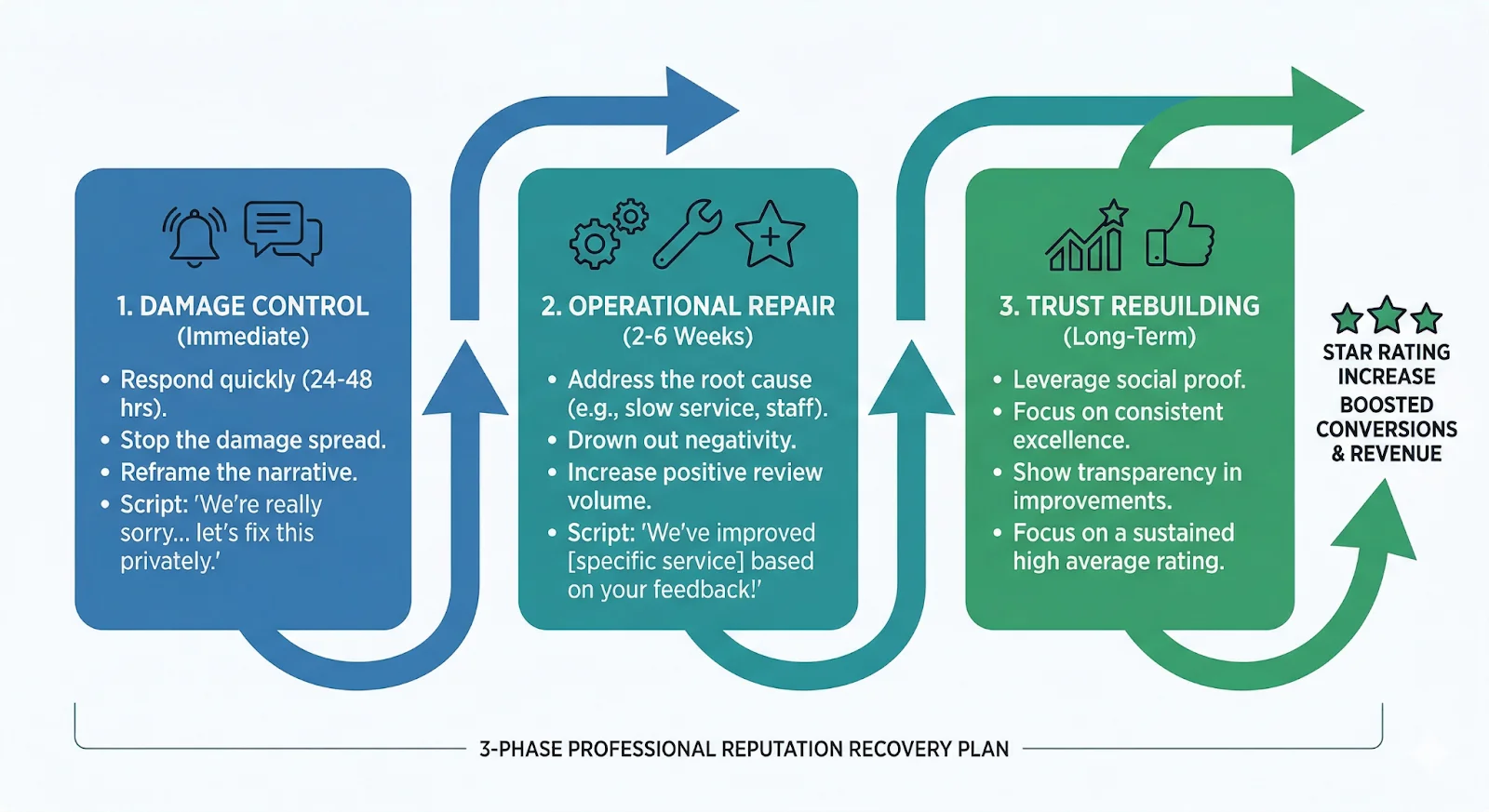
Most businesses react randomly. Real recovery follows a structured system.
Phase 1: Immediate Damage Control (Response Scripts)
Speed matters.
Businesses that respond to reviews are seen as 1.7x more trustworthy.
For a Legitimate Complaint:
"Hi [Name], thank you for bringing this to our attention. We pride ourselves on [Service Standard], and it’s clear we missed the mark. We have already addressed this with our team to ensure it doesn’t happen again. We’d like to make this right,please contact us at [Phone/Email] so we can offer a solution."
For a Vague/Emotional Review:
"Hi [Name], we’re sorry to see you had a negative experience. We’d love to learn more about what happened so we can improve. Customer satisfaction is our top priority,could you share more details with us at [Email]?"
For a Suspicious/Fake Review:
"Hi [Name], we take all feedback seriously, but we have no record of a customer interaction matching your account. If you did visit us, please reach out so we can investigate this immediately."
Phase 2: Improve Customer Experience & Generate Positive Reviews
Responses alone won’t fix your reputation,systems will.
Once issues are resolved, you need to generate consistent positive feedback.
Review Request Script:
"Hi [Name], it was a pleasure serving you! If you enjoyed your experience, would you mind leaving us a quick review? It takes less than 30 seconds: [Link]"
Consistency is key. Businesses with steady review flow are more stable and trusted.
To plan your recovery strategy more precisely, an improvement calculator can help you estimate how many 5-star reviews you need to reach your target rating.
Phase 3: Build Long-Term Trust Through Transparency
Customers don’t expect perfection,they expect honesty.
Public Improvement Update:
"Update: Based on feedback regarding our [Issue], we have implemented [Fix]. We’re committed to improving every day."
This signals accountability and builds credibility.
The Math of Star Ratings: How Many Positive Reviews Offset a 1-Star Rating?
This is one of the most common questions business owners ask.
Here’s the reality:
-
One negative review often requires 5–10 positive reviews to offset
-
The fewer reviews you have, the stronger the impact
This is why consistent review generation is critical.
If you want to see exactly how many reviews you need to recover your rating, you can use a some of review calculting tools to simulate different scenarios based on your current score.
Businesses with ongoing review flow avoid dramatic rating fluctuations.
Read more: How Many 5-Star Reviews Does It Take to Fix a 1-Star Rating?
7 Proven Strategies to Optimize Your Google Business Profile After a Crisis
Your Google Business Profile is where most customers form their first impression.
After a reputation hit, this is where you focus.
Personalizing Your Review Responses to Increase Consumer Confidence
People don’t just read reviews. They read how you respond to them.
A thoughtful, human reply signals that you care.
This directly improves purchase intent and can even recover lost customers.
Incentivize Organic Customer Feedback (The Right Way)
Many businesses are tempted to take shortcuts like buying reviews. While organic growth is the gold standard, some businesses choose to jumpstart their visibility by looking into options to get more Google reviews through verified platforms to offset an initial wave of negative feedback.
But before using that strategy, focus on:
• Automated review requests after purchase
• Friendly follow-ups
• Simple, direct links
Timing matters. Ask when the customer is satisfied.
This approach aligns with guidelines and builds real brand credibility.
Leveraging Negative Reviews as Social Proof of Business Growth
Interestingly, a perfect 5.0 rating can look suspicious.
Profiles with a mix of reviews, including some negative ones, often appear more authentic.
What matters is how you handle them.
When potential customers see:
• Honest feedback
• Professional responses
• Visible improvements
they’re more likely to trust you.
If your brand is rebuilding its reputation, our free business review generator can help you draft positive and authentic-looking review examples quickly
Strengthening Local SEO Through Consistency
Fixing your NAP consistency across directories and running a local citation audit may not sound exciting, but it matters.
Inconsistent business information can hurt your visibility in the Google Map Pack.
Cleaning this up strengthens your presence and supports your recovery.
Using Tools Without Losing the Human Touch
Reputation management software and review monitoring tools can save time, especially as you grow.
To streamline this process and ensure you never miss a notification, many top-performing brands utilize specialized online reputation management software to automate their feedback loops.
They help you track:
• New reviews
• Sentiment trends
• Response times
However, these tools should support your strategy, not replace your voice.
People still expect human interaction.
Read more: How to Respond to Negative Google Reviews
How Review Grow Can Help You Automate Your Recovery
Recovering from a bad review crisis doesn't have to be a manual, stressful grind. While the strategies above provide the blueprint, executing them consistently is where most businesses struggle.
At Review Grow, we help businesses flip the script on negative feedback by:
We help you automatically reach satisfied customers at the right moment to generate more 5-star reviews, while monitoring your listings in real time so you can respond instantly to new feedback.
For businesses dealing with a surge of negative reviews, we also provide strategic solutions to stabilize your rating and support long-term reputation recovery.
Don't let a few bad experiences define your business. Whether you need a complete online reputation management overhaul or just a boost in your monthly review volume, we’re here to help you protect your revenue and outshine the competition.
Final Verdict
Bad reviews feel personal, but they’re actually one of the most useful business signals you’ll ever get.
Handled correctly, they can:
• Expose weak points
• Improve your operations
• Strengthen customer trust
The businesses that recover fastest are not the ones that avoid criticism.
They’re the ones that listen, adapt, and respond like real people.
And in a world full of automated responses and fake perfection, that’s exactly what customers remember.
Frequently Asked Questions
How to remove fake Google reviews?
You can’t delete them directly, but you can report them through Google if they violate guidelines. Providing clear evidence increases your chances of removal.
Should I respond to every negative review?
Yes. Even if the reviewer never responds, future customers are paying attention to how you handle criticism.
How long does it take to recover from bad reviews?
Most businesses see noticeable improvement within 4 to 8 weeks if they consistently respond, fix issues, and generate new reviews.
Can bad reviews hurt my local SEO rankings?
Yes. They influence both visibility and user behavior. But strong engagement and positive review growth can reverse the impact.
What’s the biggest mistake businesses make?
Ignoring reviews or reacting emotionally instead of strategically.
Rebecca Stone
Online Reputation ConsultantRebecca Stone is an Online Reputation Consultant who's all about helping people build their brand and win over customers. She loves sharing what she knows, so she writes for the ReviewGrow blog, giving readers the scoop on how to get ahead.