What Motivates Customers to Leave a Google Review? (Data + Psychology Explained)
April 27, 2026
 Chris Patterson· Local SEO Specialist
Every Google review is the end result of a tiny psychological journey. But what makes customers to leave Google reviews is a complex process: a customer feels something, decides it's worth sharing, finds the time, and finishes the action. Most businesses obsess over the last step ("just ask for the review!") while ignoring the first three.
Quick Answer: What Motivates Customers to Leave a Google Review?
Customers leave Google reviews when three forces align: a strong emotional trigger (positive or negative experience), a frictionless review process, and a well-timed prompt asking them to share feedback. According to PowerReviews data, the top motivators are a positive experience (92%), free samples (86%), a negative experience (78%), incentives (76%), and the desire to help others (72%). However, 58% of customers need to be asked at least twice before they'll leave a review, meaning timing, ease, and persistent (but polite) follow-up matter just as much as the experience itself.
The 3-Driver Formula: Reviews = Emotion × Ease × Prompt. If any of the three is zero, the review doesn't happen.
Now let's first look at why Google reviews specifically deserve your attention over other platforms.
Why Google Reviews Matter for Businesses
Before we dive into the psychology, let's address why Google Reviews specifically deserve your attention over other platforms:
-
Local SEO impact: Google reviews are one of the top 3 ranking factors in the local pack, influencing both volume and proximity weighting.
-
Trust and conversions: According to BrightLocal, 87% of consumers read online reviews for local businesses, and 76% trust them as much as personal recommendations.
-
Social proof at the moment of decision: Google reviews appear directly in search results, Maps, and Knowledge Panels, meaning they influence customers while they're choosing.
-
Visibility compounding: More reviews = better ranking = more visibility = more reviews. It's a flywheel competitors can't easily replicate.
Understanding why people leave reviews is the key to spinning that flywheel faster.
Read more: Why Are Google Reviews Important for Business Growth?
How Often Do Customers Actually Leave Reviews?
Many business owners assume customers are reluctant to write reviews. The data tells a very different story.
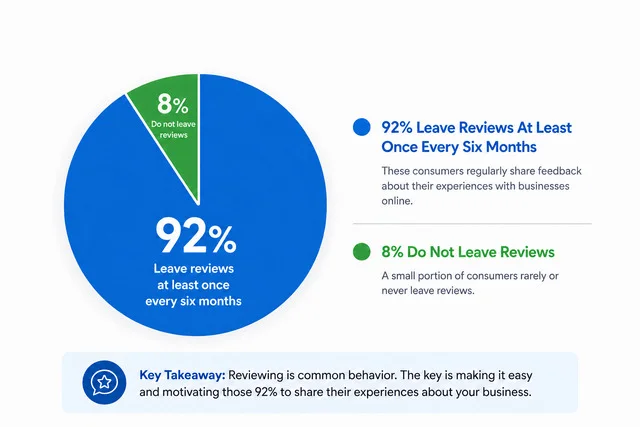
According to PowerReviews' 2023 research surveying over 9,000 U.S. shoppers:
-
92% of consumers submit reviews at least once every six months.
-
60% write reviews multiple times per month.
-
Younger consumers are even more prolific: 62% of Gen Z and 60% of Millennials write reviews multiple times per month, compared to 55% of Boomers.
The takeaway? Customers are willing to leave reviews. The bottleneck isn't willingness. It's whether your business creates the right conditions and prompts.
The Psychology Behind Customer Reviews
Customers don't leave reviews because they "should." They leave reviews when an internal psychological threshold is crossed. Here are the four main drivers.
1. Emotional Triggers (The Core Driver)
Reviews are emotional artifacts. Research consistently shows that customers are most motivated to write reviews when they experience extreme emotions, either delight or frustration. Neutral experiences rarely produce reviews because they don't generate enough psychological energy to act.
This creates the "U-shaped review curve": most reviews come from very satisfied or very dissatisfied customers, while moderately happy customers stay silent.
Implication: If you want reviews, you need to create memorable, emotionally distinct experiences, not just "good service."
2. The Reciprocity Principle
Coined by psychologist Robert Cialdini, the reciprocity principle explains why people feel compelled to give back when they receive something valuable. When a business goes above and beyond, a handwritten note, a free upgrade, a problem solved fast, customers feel a subconscious "debt." Leaving a glowing review is one of the easiest ways to repay it.
This is why small, unexpected gestures often produce more reviews than expensive loyalty programs.
3. Social Proof & Altruism (Helping Others)
Many reviewers are motivated by a genuine desire to help. PowerReviews data shows that 72% of consumers cite "helping and guiding others" as a key reason for writing reviews. This altruistic motivation explains why review communities (Google Local Guides, Yelp Elite) thrive, contributors get a sense of identity and purpose from being trusted advisors.
4. The Desire to Be Heard
Negative reviews are often less about revenge and more about being acknowledged. When a customer feels ignored, dismissed, or wronged, the public review becomes the only channel they believe will be taken seriously.
To learn exactly how to preempt these public complaints, read our deep dive on why customers are more likely to review after a bad experience.
Top Reasons Customers Leave Google Reviews
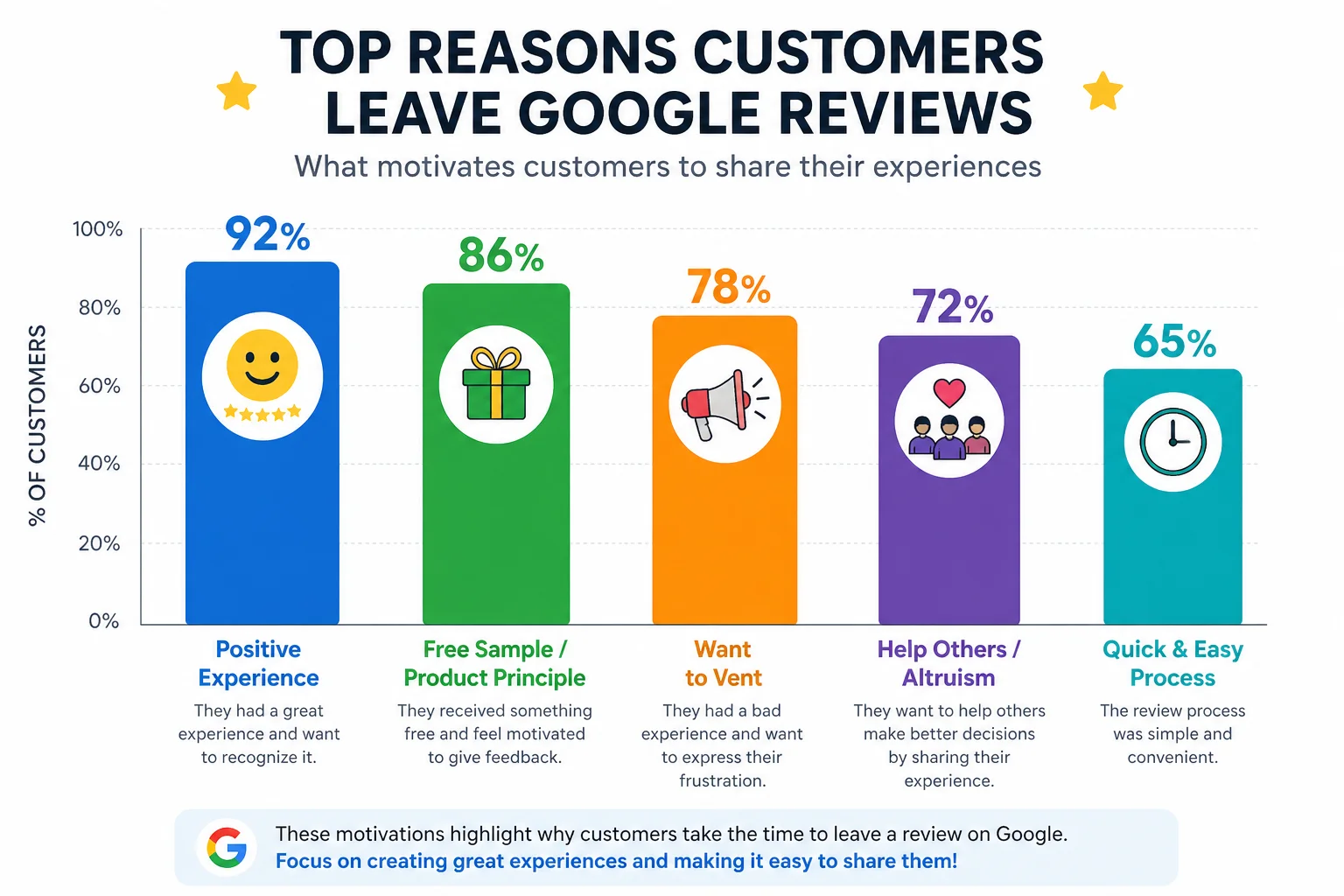
Now let's get specific. Based on consumer behavior research and review platform data, here are the top motivations, ranked:
1. They Had a Genuinely Positive Experience (92%)
PowerReviews found that 92% of consumers say a positive experience motivates them to leave a review. Delight, not just satisfaction, is the trigger.
2. They Received a Free Sample or Product (86%)
For e-commerce and product brands, free samples are the second most powerful motivator. While Google reviews don't translate directly to product samples, the principle still applies for local businesses: a complimentary service, free trial, or surprise upgrade can dramatically increase review likelihood.
3. They Want to Vent After a Bad Experience (78%)
Frustrated customers leave reviews to warn others, get a response from the business, or simply release emotion. Negative reviews often have higher word counts because emotion fuels detail.
4. They Were Offered an Incentive (76%)
Discounts, loyalty points, or exclusive perks boost participation, but be careful with Google specifically. Google explicitly prohibits offering incentives in exchange for Google reviews. You can incentivize general feedback (e.g., a survey), but not positive Google reviews. Violating this can get your listing penalized.
5. They Wanted to Help Others (72%)
The altruism trigger. Tell customers their review helps people make better decisions and you activate this motivator.
6. They Want to Help the Brand Improve (67%)
Many customers see reviews as constructive feedback. Framing your ask as "help us serve you better" can unlock this group.
7. They Were Asked Directly
A BrightLocal study found that roughly 70% of customers will leave a review if asked. Most people don't refuse, they simply forget.
8. The Review Process Was Easy
Friction kills reviews. A direct review link, QR code, or one-tap mobile flow can dramatically increase completion rates.
9. The Ask Came at the Right Moment
Asking immediately after a positive interaction, the "peak emotion" window, captures the customer while feelings are still fresh.
Why One Ask Is Rarely Enough
Here's an insight most businesses miss: a single review request usually isn't enough.
PowerReviews' 2023 data revealed a major shift from prior years:
-
Only 42% of consumers say they need to be asked just once to leave a review (down from 68% in 2021).
-
47% need to be asked twice.
-
11% need three reminders.
Younger shoppers need more nudges than older ones, 53% of Gen Z need at least two reminders compared to 42% of Boomers.
The lesson: Don't be afraid of a second (or third) ask. A polite follow-up email, SMS, or in-app message routinely doubles review submission rates.
The Generational Divide: How Different Age Groups Leave Reviews
Not all customers behave the same. If you serve a broad demographic, calibrate your approach:
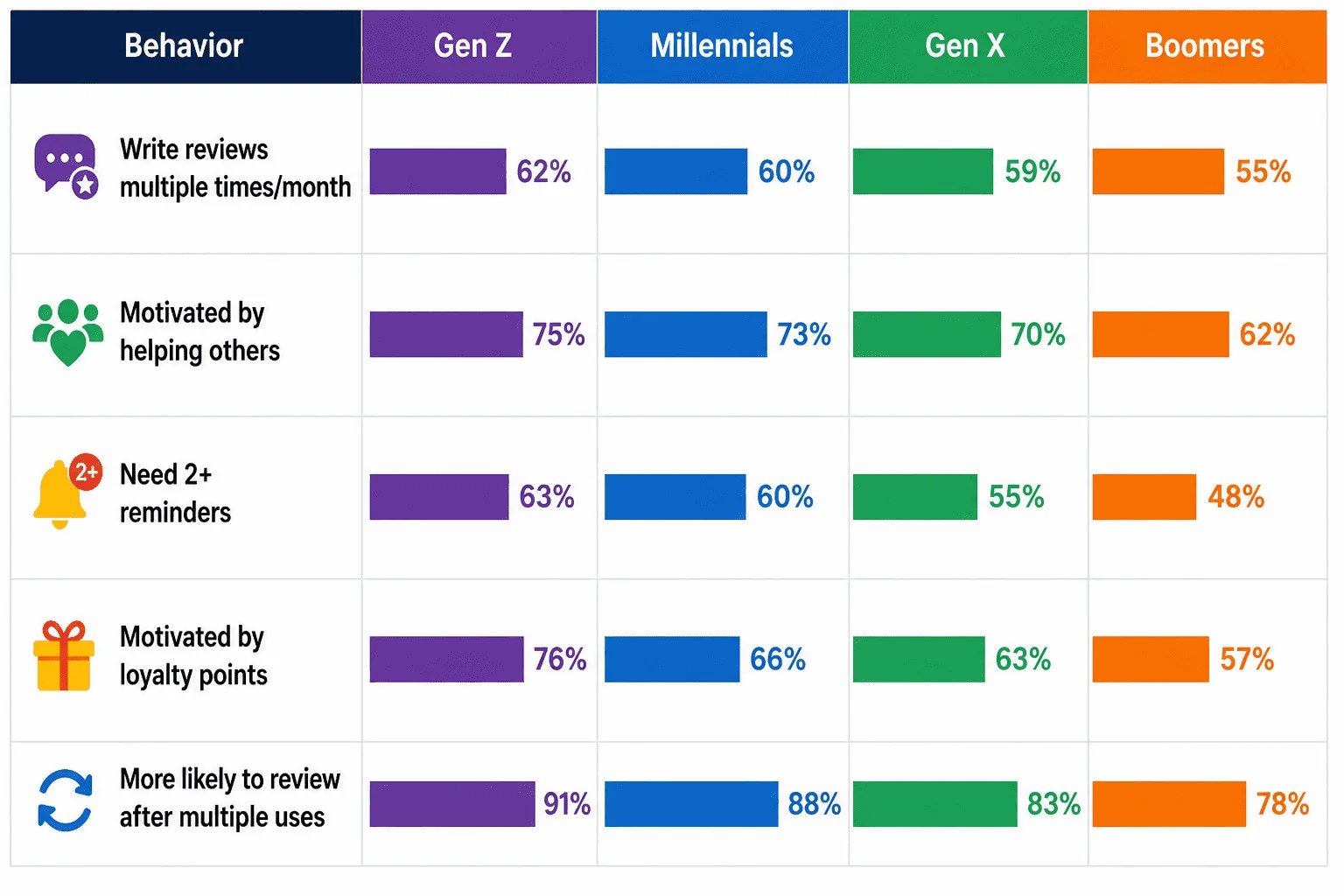
Key insight: Gen Z is the only generation that ranks loyalty points higher than discounts, and they're more motivated by altruism than by negative experiences. Younger customers respond best to community-building and gamified rewards. Older customers respond best to direct, simple asks.
What Stops Customers From Leaving Reviews (The Hidden Barriers)
Understanding what prevents reviews is just as important as understanding what motivates them.
-
Friction: Too many steps, account login requirements, or unclear directions cause drop-off.
-
Forgetting: Even satisfied customers move on with their day. Without a prompt, the moment passes.
-
No emotional trigger: A "fine" experience doesn't move people to act.
-
Privacy concerns: Some customers don't want their name publicly associated with a business.
-
Not knowing what to say: Decision paralysis is real. Customers freeze when faced with a blank text box.
-
Asked too early: 86% of consumers are more likely to review after using a product more than once. Asking before the experience matures is a missed opportunity.
-
Asked too late: 69% of consumers want to provide a review within a week of receiving the product. Wait longer and momentum dies.
Each of these is a leverage point, remove the friction, supply the prompt, and reviews follow.
Convenience is the number one motivator, which means you can generate a Google review link for free using our platform to remove all friction from the customer journey.
Timing: When to Ask for a Review
Ask too early and the customer hasn't formed an opinion. Ask too late and they've moved on. The data is clear on the sweet spot:
-
34% of consumers prefer to leave a review 5–7 days after receiving or first using a product.
-
69% are willing to leave a review within one week.
-
35% want to use a product three times before reviewing.
-
86% are more likely to leave a review after using a product multiple times.
For local services, the equivalent is "after the customer has experienced the result", not the moment the transaction ends.
Practical takeaway: Build a 2-touch sequence:
-
First request: 24–48 hours after the positive interaction or 3rd use.
-
Second reminder: 5–7 days later for non-responders.
How Existing Reviews Influence New Reviews
Here's a powerful but underused finding:
-
89% of consumers say they're more likely to leave a review for a product or business with a low volume of existing reviews, they want to fill a gap.
-
89% of consumers also say that reading existing reviews increases their likelihood of leaving on, a herd effect.
These two findings sound contradictory but actually reveal the same truth: reviews beget reviews. Once you cross a visible threshold (around 10–20 reviews), social proof kicks in and momentum builds. Below that threshold, your altruism trigger is your strongest weapon, frame your ask around "help others discover us."
The Role of Incentives (And How to Use Them Without Breaking Google's Rules)
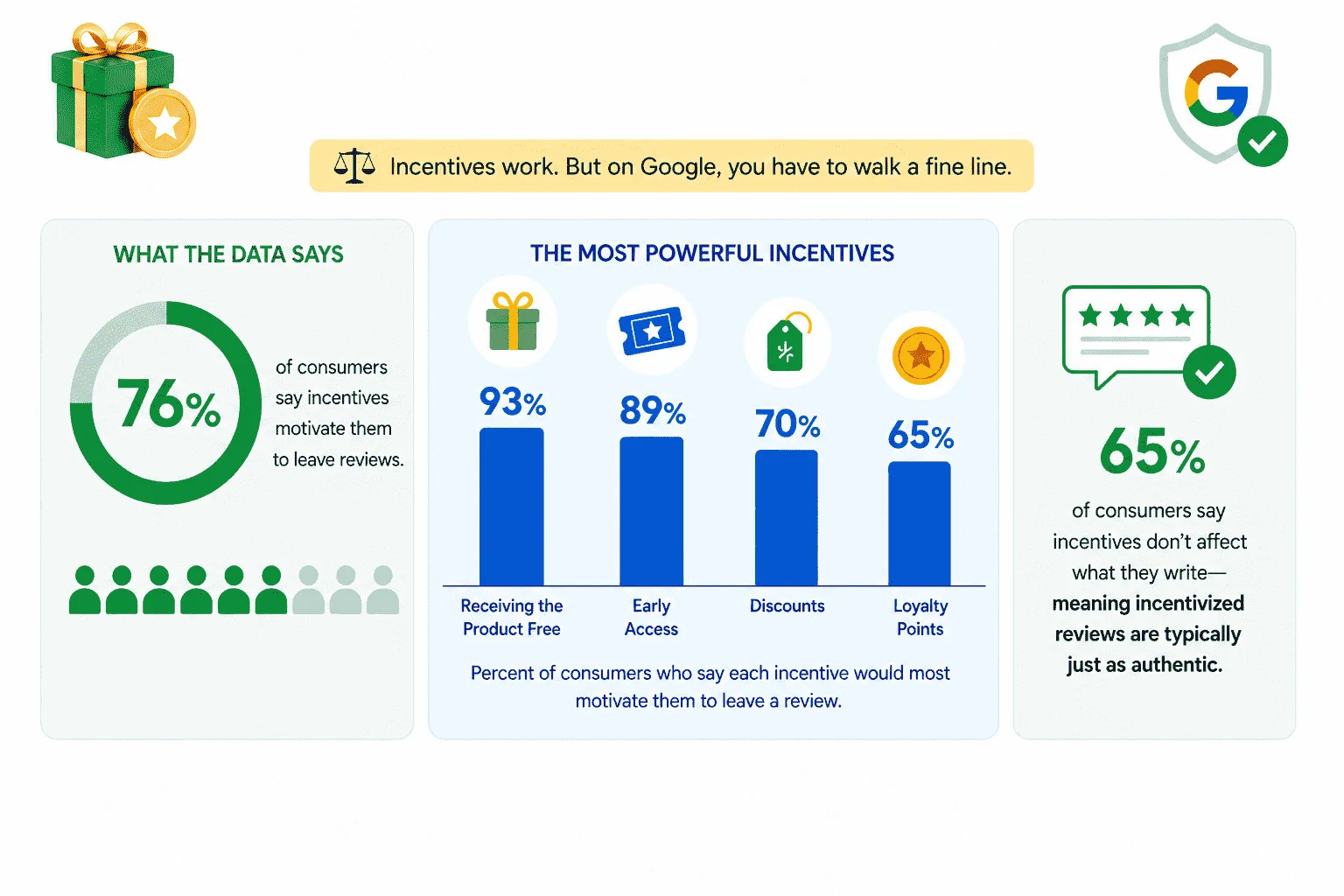
Incentives work. But on Google, you have to walk a fine line.
What the data says
-
76% of consumers say incentives motivate them to leave reviews.
-
The most powerful incentives: receiving the product free (93%), early access (89%), discounts (70%), and loyalty points (65%).
-
65% of consumers say incentives don't affect what they write, meaning incentivized reviews are typically just as authentic.
Google's rules
Google's review policies prohibit offering incentives in exchange for Google reviews specifically. That includes:
-
Discounts for posting a review
-
Entry into a giveaway tied to reviewing
-
Cash, gift cards, or free products
What you can do
-
Offer incentives for general feedback through private surveys, NPS programs, or product testing panels.
-
Use sampling programs to drive product trial, then naturally request reviews afterward (without conditioning the reward on review content).
-
For non-Google platforms, badge incentivized reviews transparently (e.g., "verified sample reviewer") to maintain trust.
Transparency matters
Even where incentives are allowed, disclose them. Modern shoppers are savvy, and authenticity is a long-term moat that no short-term review boost can replace.
Read more: How to Increase Google Reviews Without Asking Directly
Does Product Price Affect Whether Someone Leaves a Review?
Counterintuitive finding: higher prices don't significantly increase review likelihood for most consumers.
-
71% of consumers say a higher price tag doesn't increase their likelihood of leaving a review.
-
However, higher-income shoppers ($250K+) are more likely (41%) to review premium products.
-
The biggest review volume comes from products in the $11–$100 range, likely because that's where most purchases happen.
For local businesses: Don't assume your high-ticket clients will review more enthusiastically. Often, mid-tier customers are your most active reviewers because the experience feels approachable and shareable.
Google Reviews vs. Other Review Platforms
Not all reviews are equal. Here's what makes Google reviews uniquely powerful:
|
Factor |
Google Reviews |
Yelp / Niche Sites |
|
Visibility |
Embedded in search results, Maps |
Requires platform visit |
|
Search intent |
High (people searching for you) |
Mixed |
|
Trust factor |
Very high (associated with Google brand) |
Varies |
|
SEO impact |
Direct ranking factor |
Indirect |
|
Ease of leaving |
Single sign-in via Gmail |
Often requires account |
The takeaway: focusing on Google reviews delivers compounding ROI in ways other platforms simply can't match for local businesses.
How to Use These Insights to Get More Google Reviews
Here's where psychology becomes strategy. Use the 3 Drivers Framework I've developed for clients:
Reviews = Emotion × Ease × Prompt
If any of those three is zero, the review doesn't happen.
1. Ask at the Right Time
Timing follows the emotional peak. Ask:
-
Immediately after a successful service or delivery
-
After a customer thanks you (verbally or via email)
-
After a milestone (e.g., 30 days into using your product)
Avoid asking when the customer is busy, stressed, or hasn't yet experienced the value.
2. Send More Than One Request
Since 58% of customers need at least two asks, build a sequence:
-
Day 0: Service completed
-
Day 1–2: Thank-you message + review link
-
Day 5–7: Soft reminder ("If you have 30 seconds…")
3. Reduce Friction Aggressively
-
Use your Google review short link (find it in your Google Business Profile)
-
Print QR codes on receipts, packaging, or table cards
-
Send the link via SMS, open rates beat email by 5x
-
Make it work on mobile in one tap
4. Create Memorable, Emotion-Worthy Experiences
Engineer "delight moments." A surprise upgrade, a personal thank-you note, remembering a customer's name, these are the small touches that flip "satisfied" into "I have to tell someone."
5. Activate Altruism in Your Ask
Don't say "leave us a review." Say "help other [customers like you] make a confident decision." Framing taps into the 72% of consumers who are motivated by helping others.
6. Encourage Photos in Reviews (Where Possible)
Reviews with photos drive significantly more conversions. While Google reviews don't always show photos prominently, encouraging customers to add a snapshot of their experience adds richness, authenticity, and a stronger SEO signal. Mention it in your ask: "A quick photo helps a lot too."
7. Respond to Every Review — Especially the Negative Ones
Responding signals you're listening. It satisfies the "desire to be heard" for unhappy customers and reinforces reciprocity for happy ones. Businesses that respond to reviews see higher overall ratings over time.
8. Measure, Test, and Optimize Continuously
Best practices are a starting point, not an ending point. Track:
-
Request-to-review conversion rate
-
Best-performing channel (SMS vs. email vs. QR)
-
Optimal timing windows
-
Demographic differences
Test variables one at a time and let the data refine your playbook.
Read more: How to Get More Google Reviews for Your Business: Proven Ways
Case Studies
Here’s what we’ve consistently observed while working on reputation management across multiple industries.
Restaurant: The Receipt Trick
A small bistro replaced "Follow us on Instagram" on receipts with: "Loved your meal? Help other diners find us → [QR code]." Reviews tripled in 60 days. The key wasn't the QR code. It was activating altruism and providing zero-friction access.
SaaS: The In-App Trigger
A B2B SaaS company added a one-click NPS prompt after users completed a "win moment" (closing a sales deal in their CRM). Promoters were routed to a Google review link. Result: a 4x increase in monthly reviews, because the timing matched the emotional peak.
Local Service Business: The Two-Touch SMS Sequence
A plumbing company trained technicians to send a personal text 30 minutes after a job, plus a follow-up reminder 5 days later. Personal + timed + frictionless + persistent = a 47% review conversion rate (up from 18% with a single email).
The pattern is consistent: emotion + ease + prompt — repeated.
The Bottom Line
Customers leave Google reviews when three forces align: emotion drives them to act, ease removes obstacles, and a prompt reminds them at the right moment, often more than once. Master those three and you'll never struggle for reviews again.
Most businesses are stuck asking the wrong question: "How do we get more reviews?", when the better question is "How do we engineer the conditions in which reviews naturally happen?"
That shift, from chasing reviews to designing for them, is what separates brands with 50 reviews from those with 5,000.
Want more Google reviews? Start by auditing your current review request flow against the three drivers : emotion, ease, and prompt. Add a second reminder, reduce one step of friction, and time your ask to the emotional peak. Fix the weakest link first, then measure and iterate. Your review volume will compound.
Frequently Asked Questions
Why do people leave Google reviews?
People leave Google reviews primarily because of strong emotions (positive or negative), a desire to help others make decisions, gratitude (reciprocity), or because they were asked at the right time with an easy process. PowerReviews data shows positive experiences (92%) and helping others (72%) are the most common motivators.
How do you encourage customers to leave reviews?
Ask immediately after a positive interaction, send a direct review link or QR code, follow up at least once if there's no response, and create emotionally memorable experiences. Above all, just ask, most customers say yes when prompted, but 58% need to be asked more than once.
Are incentives allowed for Google reviews?
No. Google's policies prohibit offering incentives (discounts, gifts, money) in exchange for reviews. You can collect general feedback through incentivized surveys, but you cannot reward customers specifically for posting Google reviews. Violating this can result in review removal or listing suspension.
Why do customers leave negative reviews?
Most negative reviews come from customers who felt unheard, ignored, or wronged and want either acknowledgment, a resolution, or to warn others. Roughly 78% of consumers say a negative experience would motivate them to leave a review. Responding promptly and empathetically often turns these situations around, and sometimes leads to the review being updated.
What percentage of customers leave reviews?
According to PowerReviews, 92% of consumers submit reviews at least once every six months, and 60% leave reviews multiple times per month. Without prompting, that number drops dramatically, only about 5–10% will review unprompted. With a direct, well-timed ask, conversion can rise to 60–70%.
When is the best time to ask for a Google review?
Right after a positive interaction, when emotion is at its peak. For service businesses, this is immediately after job completion. For e-commerce, it's about 5–7 days after delivery, long enough for the customer to use the product multiple times (which 86% prefer), but short enough to remember the experience.
Do incentives make reviews less authentic?
According to PowerReviews, 65% of consumers say incentives don't affect what they write in a review. However, transparency is critical, always badge or disclose incentivized reviews on platforms where they're allowed.
How many times do customers need to use a product before reviewing?
35% of consumers prefer to use a product three times before leaving a review, and 86% are more likely to review after multiple uses. This makes "wait until the product is experienced" a critical part of timing.
Why do customers say they will leave a review but don’t follow through?
Most customers have good intentions but forget or face friction. Common reasons include lack of time, too many steps in the review process, or simply getting distracted. Simplifying the process with direct links or reminders significantly increases completion rates.