Can AI Write Reviews for My Business? The Policy and Legal Line You Can't Cross
April 29, 2026
 Rebecca Stone· Online Reputation Consultant
Let's answer this directly: yes, AI can write reviews for your business. The technology exists, it's accessible, and it can produce convincing, detailed feedback in seconds.
But posting those reviews as if real customers wrote them? That's where everything falls apart. It violates Google's policies, the FTC's guidelines, and the trust your potential customers place in every star rating they read. The short-term appeal of padding your review count is real, but the risks are serious enough that this article exists to show you exactly where the line is, and how to use AI in ways that actually help your reputation without putting it in danger.
Can AI Actually Write Reviews?
AI review generators have gotten remarkably good. Tools built on large language models (LLMs) like GPT-4 can generate product reviews, respond to customer reviews, create testimonials, and star ratings that sound polished, specific, and human.
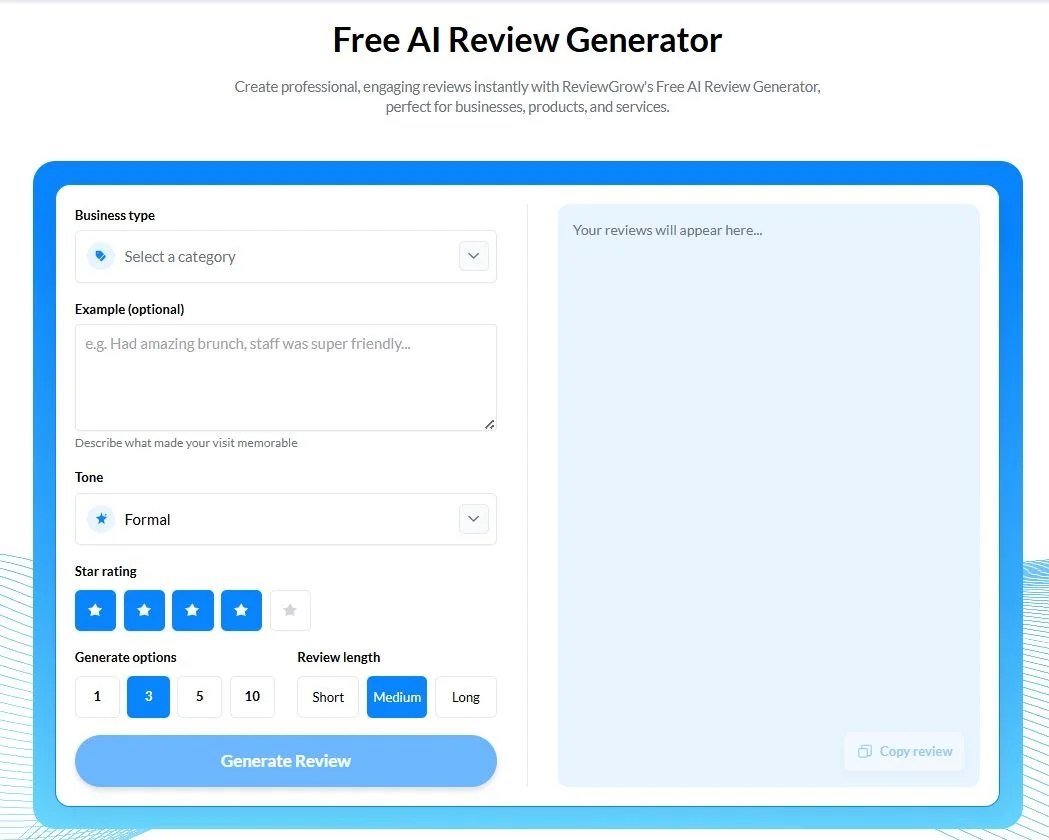
You give the tool a few inputs: your business type, the service you want reviewed, a desired tone, maybe a rating level. Within seconds, you get something like:
"Really impressed with how quickly the team handled my appointment. The technician was professional, explained everything clearly, and the pricing was fair. Will definitely be coming back."
That reads fine, right? The problem is the platforms where these reviews would live are increasingly good at detecting exactly that.
Is It Legal or Allowed to Use AI for Reviews?
This is where businesses need to pay attention closely.
Google's stance is unambiguous. Their review policies prohibit fake reviews, and Google's systems actively look for patterns that suggest review manipulation. If they detect AI-generated or fake reviews on your Business Profile, the consequences include review removal, ranking penalties, and in serious cases, suspension of your listing entirely.
Yelp goes even further, running a consumer alert program that publicly flags businesses caught attempting to generate fake reviews. That kind of label is visible to every potential customer and is extremely difficult to remove.
The FTC's position adds a legal dimension. The Federal Trade Commission requires that endorsements reflect genuine customer experiences. Posting AI-generated content as an authentic customer review is deceptive under FTC guidelines, and businesses have faced fines and enforcement actions for exactly this kind of practice. In 2023, the FTC updated its endorsement rules specifically to address AI-generated and fake reviews, signaling this is a priority enforcement area.
Platform penalties aren't theoretical. They happen regularly, and recovering from a suspended Google Business Profile or a Yelp consumer alert can take months, if it happens at all.
While AI can help draft responses, authentic customer voices matter most, so ensure a steady flow of organic text by providing clients with a free Google review link tool.
Why Businesses Feel Tempted to Use AI for Reviews
It's worth being honest about why this is such a persistent temptation, because understanding it helps you find better solutions.
A new business with three reviews looks untrustworthy next to a competitor with 200. That pressure is real. A single bad review left unanswered can drag down an otherwise excellent reputation. Asking customers for reviews feels awkward, and most people don't follow through even when they mean to. Scaling a review strategy across multiple locations or product lines feels logistically overwhelming.
These are legitimate pain points. AI seems like a shortcut that solves all of them at once. But as we'll get into below, there are ways to use AI that actually address these problems without the risk.
Read more: How to Increase Google Reviews Without Asking Directly
The Risks of AI-Generated Reviews
Platform Penalties
Google, Yelp, TripAdvisor, and other major platforms invest heavily in detecting inauthentic reviews. Their algorithms look for patterns: reviews that cluster around the same timeframe, IP address anomalies, writing styles that repeat across multiple reviews, accounts with no prior activity. AI-generated content often triggers multiple red flags simultaneously. The outcome ranges from quiet removal to public penalties that damage your credibility far more than a low review count would have.
Pro Tip: To demonstrate deeper domain expertise, reference Google’s Search Quality Rater Guidelines or specific research papers on anomaly detection, which highlight how their algorithms identify "unnatural" review patterns that deviate from normal customer behavior.
Loss of Customer Trust
Reviews exist because consumers don't trust advertising. When a potential customer reads your reviews, they're looking for the unfiltered voice of someone who has actually experienced your business. If it comes out that reviews were AI-generated (and it often does, through competitor reports, disgruntled employees, or investigative journalists), the damage to trust is lasting. It reframes every positive thing about your business as potentially manufactured.
Detectability
AI-generated reviews have tells. They tend to be grammatically perfect but emotionally flat. They often lack the specific, slightly messy detail that real customer experiences include. ("The parking was a nightmare but honestly worth it" is the kind of thing a real person writes. An AI rarely generates that kind of friction-laden authenticity.) Review platforms and increasingly savvy consumers are getting better at spotting this.
Legal Consequences
Beyond platform policies, there's growing legal exposure. The FTC has been increasingly assertive about fake endorsements, and state attorneys general have pursued cases involving manufactured reviews. For regulated industries like healthcare, finance, or legal services, the exposure is even higher. The cost of a single enforcement action dwarfs whatever short-term benefit came from the fake reviews.
How to Use AI for Reviews the RIGHT Way
Here's the good news: there are genuinely powerful ways to use AI in your review strategy that are completely ethical, platform-compliant, and effective.
1. Writing Review Response Drafts
Responding to reviews, both positive and negative, is one of the highest-impact reputation management activities you can do. It signals engagement to potential customers and improves local SEO. But it's time-consuming, especially at scale.
AI is excellent at drafting review responses. You paste in a customer review, give the AI your tone guidelines, and get a personalized, thoughtful draft in seconds. You review it, adjust it, and post it. The response is genuinely yours; the AI just did the heavy lifting of the first draft.
Pro Tip: Link your AI use to business results by quoting statistics, which show that businesses with faster response times (aided by AI drafts) often see a direct correlation with higher customer trust and conversion rates.
2. Helping Customers Structure Their Reviews
You can't write reviews for customers, but you can make it easier for them to write their own. AI can help you create prompts and guides that you share with customers after a service or purchase. Something like: "Did we solve your problem quickly? Was our team easy to work with? We'd love to hear about your experience on Google." This isn't ghostwriting reviews; it's removing the blank-page friction that stops most satisfied customers from ever leaving feedback.
3. Creating Review Request Templates
AI can help you write the emails, SMS messages, and follow-up sequences you use to ask customers for reviews. A well-crafted review request at the right moment dramatically improves response rates. This is a completely legitimate use of AI that directly increases your real review volume.
4. Sentiment Analysis
If you have a high volume of reviews, AI tools can analyze them systematically to identify themes, common complaints, and service gaps. This turns your review data into actionable business intelligence. You're not manipulating reviews; you're learning from them at scale.
5. Automating Review Request Timing
AI-powered reputation platforms can identify the optimal moment to send a review request based on customer behavior signals. A customer who just completed a purchase, had a support ticket resolved, or checked out of a stay is statistically much more likely to leave a positive review than one who gets a generic batch email three weeks later. Automating that timing intelligently is a legitimate and powerful application.
AI Review vs. Real Review: What the Difference Actually Looks Like
This comparison matters because it illustrates exactly why AI reviews underperform even when they aren't caught.
AI-generated review: "Fantastic service from start to finish. The team was professional, knowledgeable, and completed the work quickly. I would highly recommend this business to anyone looking for quality and value."
Real customer review: "Came in for what I thought was a simple fix and ended up needing more work than expected. Marcus walked me through exactly what was wrong, showed me the part, and gave me options. Wasn't cheap but I felt like I wasn't being taken advantage of. Came back two weeks later for something unrelated and he remembered my name. That doesn't happen anymore."
The AI version is grammatically fine. The real one is credible. It has friction, a name, a specific moment, and an emotional observation. That's what prospective customers are looking for when they read reviews, and it's what AI fundamentally cannot manufacture at scale without it becoming obvious.
Use Trusted AI Tools for Ethical Review Management
Not all AI review tools are built the same, and choosing the right one makes a significant difference in both results and compliance.
ReviewGrow's AI review generator is built specifically for ethical, policy-compliant reputation management. Rather than fabricating reviews, it helps businesses generate more authentic ones by automating review request sequences, crafting personalized outreach messages, and drafting response templates that keep your team consistent and fast.
The AI works behind the scenes to remove friction from the review process, so real customers are more likely to actually follow through and leave feedback.
AI writing assistants are useful for drafting response templates, building follow-up email sequences, and quickly analyzing themes when you paste in a batch of recent reviews. They're general-purpose tools rather than review-specific, so they work best when paired with a structured workflow.
Local SEO monitoring tools give you visibility across all the platforms where reviews about your business appear, helping you prioritize where to focus your outreach and catch new reviews quickly so responses go out while the conversation is still warm.
The common thread across all of these is that they help you earn and manage real reviews more effectively. None of them are a substitute for the authentic customer voice, and the best ones aren't trying to be.
How to Get More Real Reviews (Without the Risk)
The most effective review strategies are simpler than most businesses think.
Timing is everything. Ask for a review immediately after a positive interaction, not days later. The emotional peak is real, and it fades fast.
Make it frictionless. A direct link to your Google review form, sent via SMS or email, removes every barrier between a satisfied customer and a posted review. The fewer steps, the higher the conversion.
QR codes at point of sale work exceptionally well for in-person businesses. A small card or table tent with a QR code and "Enjoyed your visit? Let us know on Google" takes two seconds to act on.
Follow up once. A single reminder sent a few days after the initial request meaningfully increases response rates without feeling aggressive.
Train your team. The best review request often comes from a person, not automation. A simple "If you have a moment, a Google review would really help us out" at the right moment outperforms most automated sequences.
Read more: How to Get More Google Reviews for Your Business
Final Verdict
AI is a genuinely useful tool for reputation management. It can help you respond faster, ask smarter, analyze better, and communicate more consistently. None of that requires you to fabricate a single review.
What AI cannot do ethically is replace the voice of your real customers. That voice is what reviews are for. It's what your prospects are looking for, and it's what search algorithms are designed to surface and protect. Fake it, and you're not just risking your rankings. You're risking the foundation of trust your business depends on.
Use AI as the assistant it is, not as a substitute for the real thing.
Frequently Asked Questions
Can AI write Google reviews for my business?
Technically yes, AI can generate text that looks like a Google review. But posting it on your Google Business Profile as a real customer review violates Google's policies and can result in review removal, ranking penalties, or suspension of your listing.
Is it illegal to use AI for reviews?
Using AI to generate fake reviews that are posted as real customer experiences runs afoul of FTC endorsement guidelines and can expose your business to legal liability. The FTC updated its rules in 2023 specifically to address this. Beyond federal guidelines, some states have their own consumer protection laws that apply.
Can AI help me respond to reviews?
Absolutely, and this is one of the best legitimate uses of AI in reputation management. AI tools can draft personalized responses to customer reviews quickly and at scale. You review and edit the drafts before posting, keeping the process both efficient and authentic.
Can I automate review requests safely?
Yes. Automating the process of asking satisfied customers for reviews is completely legitimate and widely used. The key is that you're requesting authentic feedback from real customers, not generating or incentivizing specific content. Timing automation, personalized messaging, and multi-channel follow-ups are all fair game.
What happens if Google detects AI-generated reviews?
Google's systems look for patterns associated with fake or manipulated reviews. Detected fake reviews are removed, and repeated violations can result in your Business Profile being penalized or suspended. Recovery from suspension is a lengthy process with no guaranteed outcome.
How can I increase my review count without using AI to write reviews?
Focus on timing your requests, making it easy with direct links or QR codes, training your team to ask in person, and following up once with customers who didn't respond initially. Reputation management tools that automate request sequences at the right moment consistently outperform manual methods.
Rebecca Stone
Online Reputation ConsultantRebecca Stone is an Online Reputation Consultant who's all about helping people build their brand and win over customers. She loves sharing what she knows, so she writes for the ReviewGrow blog, giving readers the scoop on how to get ahead.