How Many Google Reviews Do You Need to Rank in a Local Pack?
March 10, 2026
 Chris Patterson· Local SEO Specialist
There is no universal number of Google reviews required to rank in the Local Pack. However, data from large local SEO studies shows that businesses appearing in the top three Google Maps results usually have around 40 to 50 reviews on average, along with strong ratings and consistent new reviews.
What matters more than hitting a specific number is how your review profile compares to competitors and how frequently you receive fresh reviews.
Key Takeaways
-
10–15 reviews – the minimum to start appearing in local search results.
-
40–50 reviews – the average for businesses ranking in the Local Pack.
-
75–100 reviews – gives a strong competitive advantage in many markets.
-
150+ reviews – signals authority and strong local reputation.
-
4.0+ star rating – often the minimum for “best of” or filtered searches.
-
Review recency matters – about 73% of users trust recent reviews most.
-
Competition matters – the reviews you need often depend on how many your competitors have.
-
Volume, rating, and freshness together influence Local Pack rankings.
What Is the Google Local Pack?
The Google Local Pack, sometimes called the Google 3 Pack, is the block of three businesses that appears at the top of search results when someone searches for local services.
You have likely seen it when searching for things like:
-
plumber near me
-
dentist in Chicago
-
coffee shop nearby
Each listing typically shows:
-
business name
-
star rating
-
number of reviews
-
address and phone number
-
opening hours
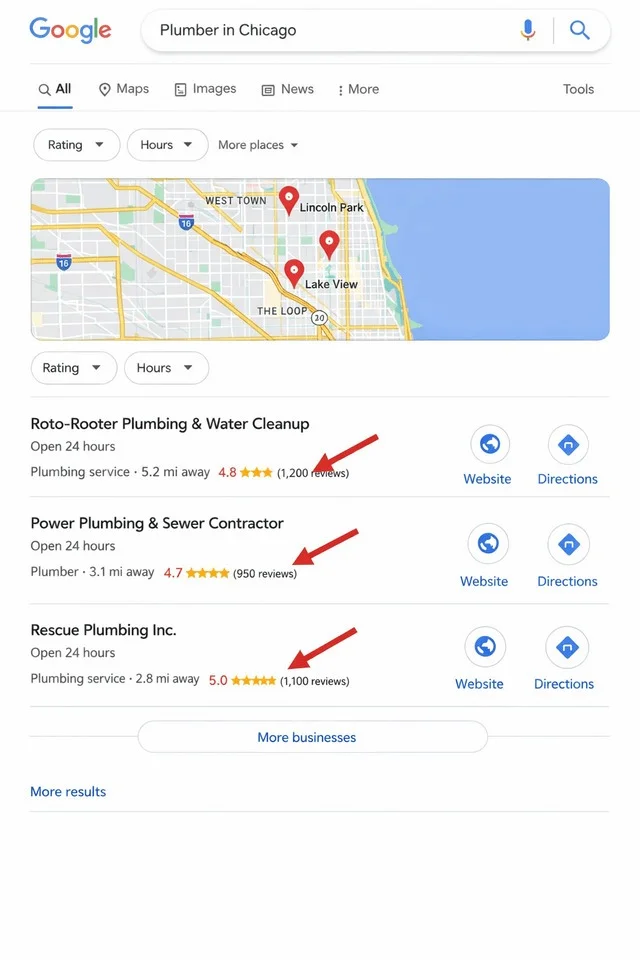
Because this section appears above organic search results, it receives a large share of clicks and phone calls.
For local businesses, ranking in this section can dramatically increase visibility and customer inquiries. Local businesses aiming to boost visibility can experiment with this AI review generator online to create engaging review samples that support trust signals.
How Google Actually Evaluates Reviews
Many people assume that Google simply ranks businesses by who has the most reviews.
If that were true, massive chains would dominate every search result.
Instead Google evaluates several review signals together.
These include:
-
total review quantity
-
star rating
-
review velocity
-
review recency
-
keywords inside reviews
Research from local SEO experts shows that review signals represent about 16 percent of Google Local Pack ranking factors, making them the second most influential signal group after Google Business Profile optimization.
At ReviewGrow, we analyze thousands of local search results to understand what actually influences Local Pack rankings. One factor consistently stands out: the number and freshness of Google reviews.
You can also use this Google review rating calculator to estimate how many additional 5-star reviews it may take to strengthen your overall profile.
Google Local Pack Ranking Factors
Data from industry experts reveals the approximate weight of different ranking signals.
Local SEO Ranking Factors
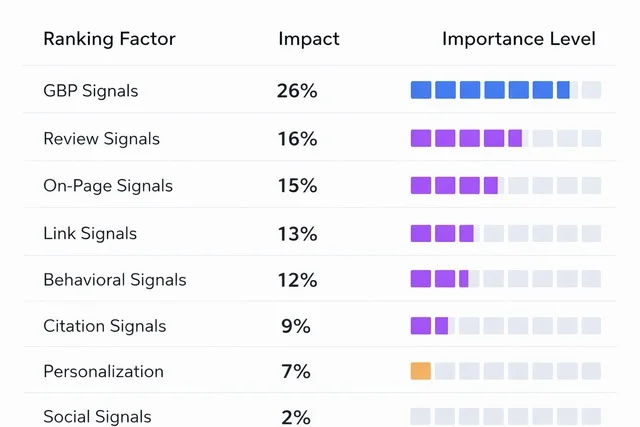
This means reviews alone cannot guarantee rankings, but they are still one of the strongest factors businesses can control.
Quantity and frequency are key ranking signals, so you can use this free Google review link generator to get more reviews and outpace your local competitors.
Review Thresholds That Unlock Ranking Potential
Large scale studies analyzing tens of thousands of businesses have identified several key review thresholds.
Each level tends to unlock stronger ranking potential.
The Review Milestone Roadmap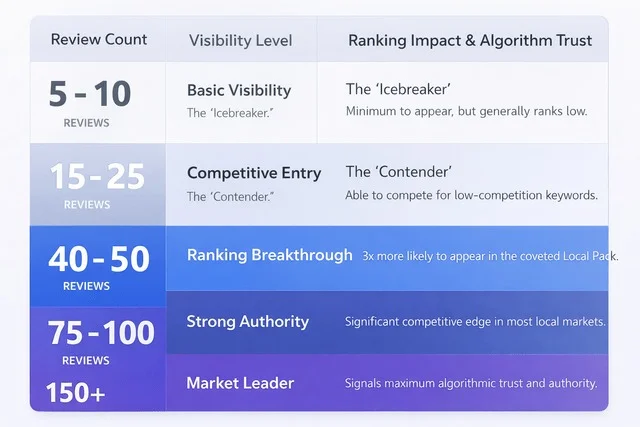 The important thing to remember is that these numbers are relative to competition.If competitors average 80 reviews, a business with 50 reviews will still struggle to rank.
The Power of "Review Justifications"
Google doesn't just count your online reviews; it reads them. When a user searches for a specific service like "emergency pipe repair," Google looks for "justifications" within your reviews to prove you can do the job.
-
What it looks like: A small bold snippet in the Local Pack that says: "They did a great job with my emergency pipe repair."
-
The Strategy: Don't just ask for a review. Ask for a story.
-
Instead of: "Please leave us a review."
-
Try: "Could you mention the specific service we provided today? It helps other neighbors find the right help!"
Why Review Velocity Matters More Than Volume
Many business owners focus entirely on reaching a certain number of reviews.
But Google evaluates something even more important.
Review velocity.
Velocity refers to how frequently a business receives new reviews over time.
Consider these two scenarios.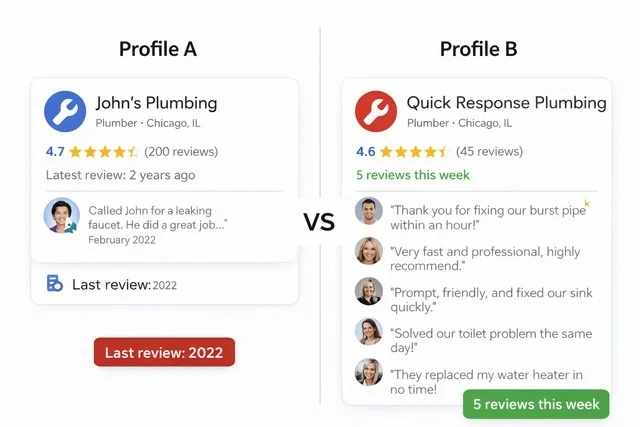 Despite having fewer total reviews, Business B often ranks higher because Google sees active customer engagement.
Fresh reviews signal that a business is currently serving customers successfully.
Old reviews tell a different story. They suggest a business may no longer be active or relevant.
If you want to accelerate that growth, you can explore our buy Google reviews service designed to help businesses strengthen their local reputation and visibility.
The Review Recency Effect
Consumers evaluate review freshness in a similar way.
Research shows that 73 percent of customers only trust reviews written within the last 30 days.
Google likely interprets freshness similarly.
Here is how review value tends to decline over time.
|
Review Age |
Relative Importance |
|
Last 30 days |
100% |
|
Last 90 days |
85% |
|
6 months old |
60% |
|
1 year old |
35% |
|
2+ years old |
15% |
This explains why businesses that gained many reviews years ago sometimes lose rankings.
Without fresh feedback, the algorithm assumes the business is no longer actively engaging customers.
Why Competitor Benchmarks Matter More Than Universal Numbers
The biggest mistake many businesses make is searching for a universal target.
Local SEO does not work that way.
Google compares businesses within the same geographic and industry context.
For example:
If competitors average 30 reviews, a business with 40 reviews may rank well.
If competitors average 120 reviews, a business with 40 reviews may not even appear in the Local Pack.
A simple rule many local SEO experts recommend is this.
Your review target should be about 20 percent higher than the average of your top competitors.
If you’re unsure how many reviews you actually need to stay competitive, you can use a Google review calculator to estimate the ideal number based on your market and competitors.
Industry Review Benchmarks
Different industries generate reviews at very different rates.
A restaurant may serve hundreds of customers each week. A law firm may only have a few clients per month.
Here are realistic review velocity benchmarks by industry.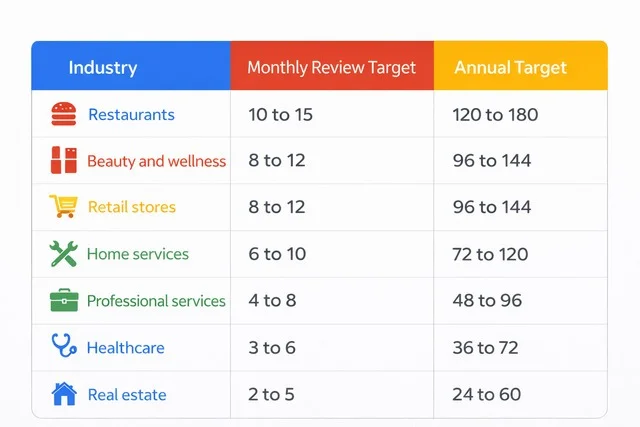 The key idea is to stay competitive within your industry and location, not across completely different markets.
The Importance of Star Ratings
Review quantity alone is not enough.
Star rating also plays a critical role in visibility.
Businesses with ratings below 4.0 stars often struggle to appear in searches containing words like “best” or “top rated.”
Here is how ratings typically influence perception.
|
Rating |
Impact |
|
Below 4.0 |
Often excluded from best searches |
|
4.0 to 4.1 |
Visible but less trusted |
|
4.2 to 4.7 |
Strong trust zone |
|
4.8 to 5.0 |
Excellent but sometimes perceived as unrealistic |
Many studies show that customers actually trust slightly imperfect ratings more than perfect scores because they appear more authentic.
The "Perfect 5.0" Trap
While a 5.0-star rating sounds ideal, it can actually be a conversion killer. Modern consumers are skeptical; a perfect profile often triggers "fake review" alarms.
-
The Trust Zone: Data suggests that a 4.2 to 4.8 rating is the "sweet spot" for conversions. It shows that your business is real, transparent, and capable of handling issues.
-
Turning Lemons into SEO Gold: A professional, empathetic response to a 3-star review often builds more trust with a prospective customer than ten 5-star reviews with no comments. It proves there is a human behind the brand who cares about customer satisfaction.
How to Get More Google Reviews Consistently
Collecting reviews should not be treated as a one time campaign. It should be an ongoing system.
Using a structured review generation strategy can help you consistently collect high-quality, authentic feedback over time.
Here are some practical strategies:
- Ask customers shortly after a successful interaction. Timing is crucial because review response rates drop significantly after a few days.
- Send review requests through email or SMS so customers can leave feedback quickly.
- Use QR codes on receipts, packaging, or business cards to simplify the process.
- Respond to every review. Engagement signals activity and professionalism.
These small actions gradually build a strong review profile.
Pro Tips to Improve Local SEO Trust
Search engines evaluate local businesses based on credibility, activity, and the quality of customer feedback. Strong trust signals help both search engines and potential customers feel confident choosing your business.
Here are a few practical ways to strengthen those signals:
Share Real Customer Experiences and Case Studies
Publishing real examples of customer results, testimonials, or short case studies adds authenticity and demonstrates the real value of your services.
Keep Your Google Business Profile Active and Updated
Regularly updating your business hours, adding new photos, and keeping service descriptions accurate shows that your business is active and reliable.
Respond Professionally to All Reviews
Thoughtful responses to both positive and negative reviews show that you care about customer experience and that your business is engaged with its audience.
Encourage Specific Details in Customer Reviews
Reviews that reference things like “water heater repair,” “balayage hair color,” or a specific team member provide helpful context about what your business offers.
Focus on Detailed and Authentic Feedback
Specific details inside reviews help search engines better understand your services and improve your chances of appearing for relevant local searches.
Final Verdict
There is no single “magic number” of Google reviews that guarantees a Local Pack ranking. However, businesses that consistently collect 40–100 high-quality, recent reviews tend to gain a clear competitive advantage in most local markets.
The key is not just the total number of reviews, but also review freshness, detailed feedback, and steady growth over time. Businesses that actively manage their reputation and encourage authentic customer reviews send stronger trust signals to both search engines and potential customers.
Frequently Asked Questions
How many reviews do you need to rank in the Local Pack?
Most businesses that appear in the Local Pack have around 40 to 50 reviews, although competitive markets may require significantly more.
Are Google reviews a ranking factor?
Yes. Review signals such as quantity, rating, velocity, and recency are one of the most important factors influencing local search rankings.
Do more reviews help Google Maps rankings?
Generally yes. Businesses with more positive and recent reviews often appear more trustworthy and therefore rank higher.
What matters more, review quantity or review freshness?
Fresh reviews are often more important than total volume. Businesses receiving new reviews regularly tend to rank higher than those with many old reviews.