How Review Sentiment Affects Local SEO (And How to Optimize for It)
June 18, 2026
 Chris Patterson· Local SEO Specialist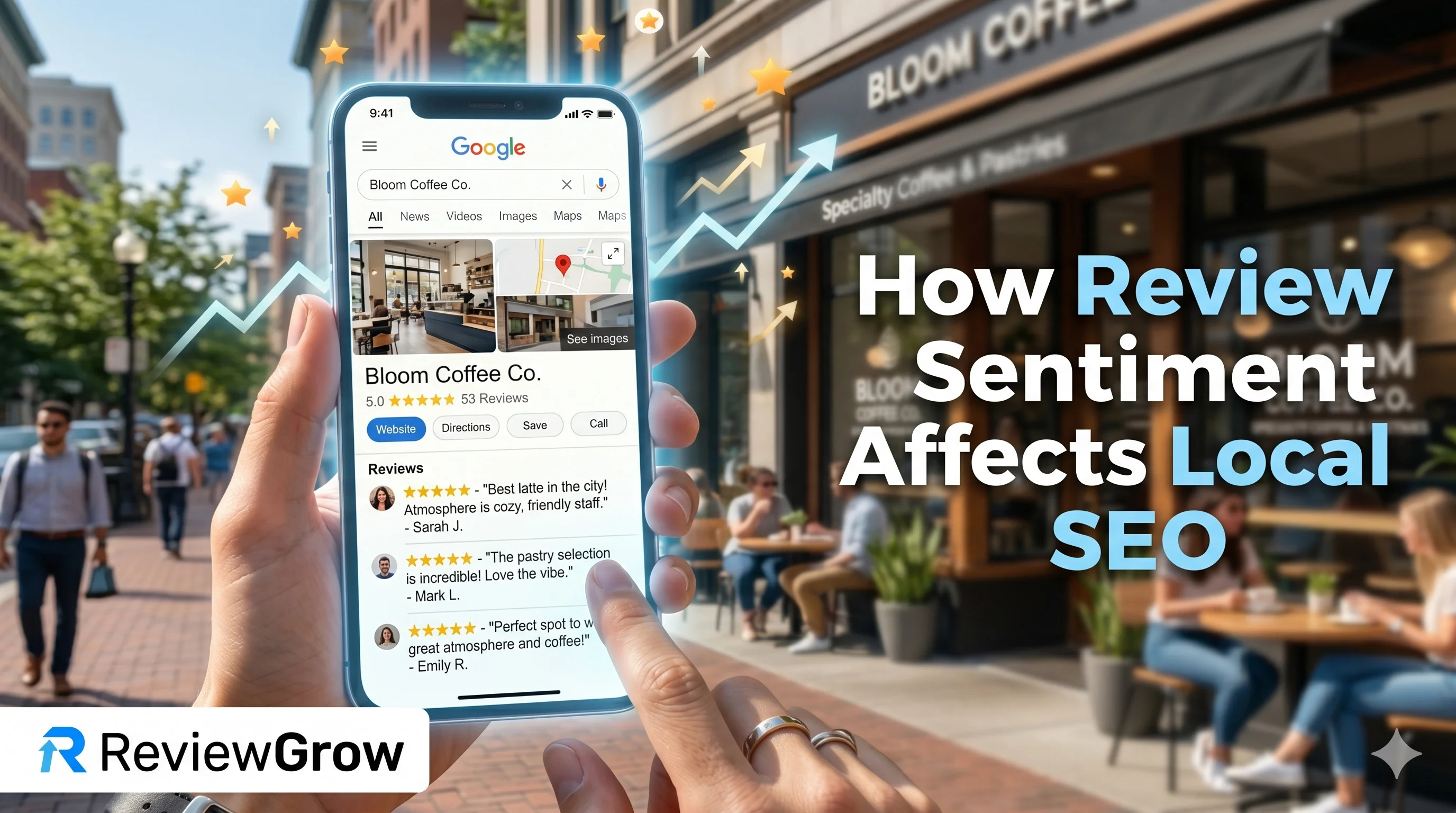
Understanding how review sentiment affects local SEO is the difference between a strategy that flatlines and one that compounds visibility over time. By prioritizing sentiment-rich reviews, you create a compounding asset that helps to boost local SEO and improve your visibility in the Local Pack.
Beyond the Star Rating: What Is Review Sentiment?
Star ratings are blunt instruments. A 4-star review tells Google almost nothing about your business beyond a numerical approximation of customer satisfaction. Review sentiment is what lives inside the text.
Sentiment analysis is the process by which natural language processing (NLP) algorithms interpret the tone, emotional intent, and specific phrasing embedded in customer feedback. Google's AI does not just scan for positive or negative language. It extracts entities, identifies service descriptors, parses contextual relevance, and maps that language to search queries.
Here is the clearest way to see the gap:
|
Review Type |
Content |
SEO Value |
|---|---|---|
|
Low-Value (Generic) |
"Great service! Highly recommend." |
Minimal. No entity extraction, no keyword signal, no contextual relevance. |
|
High-Value (Sentiment-Rich) |
"Best gluten-free pastry crust in Seattle. The team was fast and the price was fair." |
High. Google extracts "gluten-free pastry crust," "Seattle," "fast," and "fair price" as entities tied to your business. |
The second review is doing SEO work your website copy might not even be doing. That is the shift every local business needs to understand: semantic prominence, how AI understands what your customers actually say, now outweighs a raw 5-star average.
The Mechanics: How Google Uses Review Sentiment for Local Rankings
Impact on Prominence (The Reputation Pillar)
Google's local algorithm evaluates three core signals: relevance, distance, and prominence. Prominence is where review sentiment lives.
A critical mass of text-validated positive sentiment tells the algorithm that your business carries real-world authority and trust. When Google's NLP engine repeatedly surfaces descriptors like "professional," "reliable," "fast turnaround," or "family-friendly" across dozens of reviews, those signals accumulate into a reputation fingerprint. That fingerprint directly influences your Local 3-Pack visibility.
Generic reviews keep your prominence score flat. Descriptive, sentiment-rich reviews build it continuously.
Read more: How Many Google Reviews Do You Need to Rank in a Local Pack?
Impact on Relevance (Keyword and Entity Extraction)
Google's machine learning models do not wait for you to optimize your Google Business Profile. They extract meaning from your reviews in real time.
When a customer writes, "The best gluten-free pastry crust in Seattle," Google processes:
-
Entity: gluten-free pastry crust
-
Qualifier: best
-
Location modifier: Seattle
That review now contributes to your relevance for "gluten-free bakery Seattle" searches — even if those exact words never appear on your website. Contrast that with a generic 5-star review that says "Great!" — Google extracts nothing from it. It moves the needle on rating average and nothing else.
This is why I consistently tell clients: the quality of review language matters more than the quantity of reviews.
The Hidden SEO Value of Positive Textual Sentiment
Increased Click-Through Rates (CTR) and Map Interactions
Google regularly surfaces review snippets directly inside the Local Pack listing. A result that shows "Best gluten-free bakery in the neighborhood, staff remembered my order" generates far more clicks than one that shows nothing descriptive.
Higher CTR from the Local Pack sends Google a direct engagement signal. It validates the ranking, reinforces the authority, and creates a compounding visibility loop. Better sentiment drives more clicks; more clicks reinforce the ranking; a stronger ranking attracts more reviews.
This loop is real and measurable. Businesses that actively cultivate descriptive reviews see sustained CTR advantages over competitors with higher star averages but weaker textual content.
User-Generated Content (UGC) as Continuous Optimization
Your customers write things about your business that you would never think to put on your website. They mention specific neighborhood names, reference niche use-cases, and describe problems your product solved in language that mirrors exactly how other potential customers search.
A dental practice's website might target "teeth whitening Los Angeles." But a review that says "I came in with 15-year-old coffee stains and left with visibly whiter teeth in one session in Silverlake" does targeting work the website cannot replicate, naturally, organically, and continuously.
Positive textual sentiment is UGC-driven long-tail keyword coverage at scale. You cannot buy it. You can only earn it and strategically encourage it.
The Algorithmic Danger of Negative Sentiment
Negative sentiment is not just a reputation problem. It is an active ranking suppressor.
When Google's NLP engine identifies repeated negative phrases across your reviews — "long wait times," "rude staff," "overpriced for the quality," "couldn't reach customer service" — it builds a negative entity profile around your business. This dilutes local ranking visibility even when your technical SEO is strong and your website is fully optimized.
Google's core mission is surfacing businesses that provide excellent user experiences. Verified, repeated negative sentiment is direct evidence of poor user experience. The algorithm responds by demoting businesses that generate it, regardless of how many citations, backlinks, or keywords they have elsewhere.
Key risks of unmanaged negative sentiment:
-
Suppressed Local 3-Pack visibility for high-intent queries
-
Reduced snippet appeal, lowering CTR from map results
-
Diluted entity association (repeated complaints create negative entity links)
-
Compounding reputation damage as algorithmic demotion feeds lower visibility, which reduces the chance of new positive reviews rolling in
The businesses I have seen recover from negative sentiment spirals all shared one trait: they addressed the operational issues generating the complaints before attempting to counter the sentiment.
5 Advanced Strategies to Optimize for Review Sentiment
1. Prompting for Descriptive Feedback (Avoiding the "Great!" Trap)
The single most effective thing you can do is change how you ask for reviews. A request that says "Please leave us a review" produces generic responses. A request that guides the customer toward specificity produces sentiment-rich content.
Prompts that generate high-value sentiment:
-
"What specific service did we help you with today, and how did the team do?"
-
"What made you choose us over other options, and was the experience worth it?"
-
"Can you describe what the result looked like and how it compared to what you expected?"
These prompts work because they mirror natural conversational language, which is also the language Google's NLP engine parses most effectively. Customers describing their experience in their own words — what service, what problem, what outcome — produce reviews loaded with extractable entities.
Read more: How to Increase Google Reviews Without Asking Directly
2. Smart Review Response Architecture
Your responses to reviews are also indexed by Google. They contribute to the textual footprint around your business. Most businesses waste this real estate with "Thanks so much! We appreciate you!"
A strategically crafted response does several things at once:
-
Acknowledges the specific service or product mentioned
-
Reinforces location context naturally (e.g., "We're glad the team at our downtown Portland location could help")
-
Signals customer care standards to the algorithm
For positive reviews: Mirror the service language, add a location or differentiator, and invite return business.
For negative reviews: Acknowledge the specific complaint, describe the corrective action, and take the resolution offline. Do not keyword-stuff, do not be defensive, and do not dismiss the concern. Google reads your response tone as a signal of your customer care standards.
Read more: How to Respond to Negative Google Reviews
3. Eliminating Review Gating Practices
Review gating — the practice of filtering customers before asking for reviews, sending only happy customers to Google while directing unhappy ones to private feedback forms — is a direct violation of Google's review policies.
Beyond the compliance risk, it creates a false sentiment landscape that is increasingly difficult to maintain. If your review pool only reflects your best 20% of interactions, the other 80% will eventually find another outlet. The operational gaps that caused negative experiences do not disappear because you did not collect a review about them.
Treating all feedback with transparency does more for your long-term sentiment profile than gating. It also forces genuine internal improvements, which drive genuinely better reviews organically.
4. Utilizing Sentiment Analysis Software Tools
Manual review monitoring breaks down at scale. Sentiment analysis platforms automate the process of tracking text patterns across all your review sources.
The strategic value of these tools is operational, not just reputational. When sentiment analysis flags a spike in mentions of "long wait times" across your reviews, that is not primarily a reputation alert. It is an operational signal that staffing, booking, or workflow has a problem that needs fixing before it becomes a ranking suppressor.
What to track with sentiment analysis tools:
-
Recurring negative descriptors (operational red flags)
-
Emerging positive descriptors (signals to amplify in your own content)
-
Sentiment trends over time across locations
-
Competitor sentiment benchmarks where available
Catching negative patterns early and fixing the underlying issues is the cleanest way to protect and improve your local sentiment profile.
5. Displaying Sentiment-Rich Testimonials on Your Local Landing Pages
Your best reviews should not only live on Google. Embedding sentiment-rich testimonials directly on your local landing pages, marked up with Review schema (following Google Search Central's structured data guidelines), passes semantic value back to search engines through your own domain.
Schema-marked reviews tell Google:
-
The reviewer's name and rating
-
The specific service or product referenced
-
The date of the experience
This creates a reinforcing loop between your website's entity signals and your Google Business Profile's review content. When both sources consistently reference the same service descriptors and location context, your relevance signals amplify across the board.
Implementation checklist for testimonial schema:
-
Use Review or AggregateRating schema on local landing pages
-
Include itemReviewed, reviewRating, author, and datePublished properties
-
Prioritize testimonials that include specific service names, location references, and outcome descriptions
-
Validate implementation through Google's Rich Results Test before publishing
Read more: Do Google Reviews Help SEO? Local Ranking Factors Explained
Final Take
Review volume gets you in the game. Review sentiment determines how well you play it.
The businesses winning in local search are not necessarily the ones with the most reviews or the highest star averages. They are the ones generating consistent, descriptive, entity-rich feedback that Google's NLP engine can extract, interpret, and map to relevant local searches. They are also the ones managing their operational experience tightly enough that negative sentiment patterns never accumulate into ranking suppressors.
This is a long-term compounding asset, not a one-time tactic. Every descriptive review your business earns today contributes to the semantic footprint that will drive Local 3-Pack visibility for the next twelve months.
If you are ready to build a review sentiment strategy that systematically improves your local rankings and online reputation, try out our reputation management tools to get started.
Frequently Asked Questions
How does review sentiment differ from review volume?
Review volume measures how many reviews you have. Review sentiment measures the language quality and emotional content inside those reviews. You can have 500 reviews and weak sentiment if they are all generic. A business with 80 detailed, descriptive reviews can outrank you on sentiment-driven signals.
Does Google actually read the text of my reviews?
Yes. Google uses Natural Language Processing and machine learning to extract entities, tone, and contextual descriptors from review text. This feeds directly into its understanding of what your business does, where it operates, and how well it serves customers.
Can negative reviews permanently damage my local SEO?
Not permanently, but persistent negative sentiment in high volume is an active ranking suppressor. The most reliable path to recovery is fixing the operational issues generating complaints, then generating new positive sentiment at scale through improved customer experiences and strategic review prompts.
Does responding to reviews help SEO?
Yes. Your responses are indexed and contribute to your business's textual footprint. Strategic responses that reference service details, location context, and customer care practices add additional entity-rich content to your profile.
How do I know if my review sentiment is improving?
Track recurring descriptors, response rates, and the ratio of specific to generic review language over time using a sentiment analysis tool. An improving sentiment profile shows fewer repeated negative phrases and more varied, descriptive positive language appearing across new reviews.
Can review sentiment impact my Google Business Profile rankings?
Yes. Review sentiment helps Google understand customer satisfaction beyond star ratings alone. Positive reviews that mention specific products, services, staff, or locations provide stronger ranking signals than generic praise because they give Google more context about your business.
What types of review language improve local SEO the most?
The most valuable reviews contain detailed descriptions of real customer experiences. Mentions of your services, products, location, staff members, and outcomes help Google connect your business with relevant local searches and customer intent.
Are detailed reviews better than five-star reviews without comments?
In most cases, yes. A five-star rating helps, but a written review provides additional context that search engines can analyze. Reviews that explain why a customer was satisfied often contribute more SEO value than ratings alone.
Can review sentiment help my business appear for more keywords?
Yes. Customers naturally use different words and phrases when describing their experiences. Over time, these reviews create a broader keyword footprint that can help your business appear in a wider range of local and service-related searches.
How many reviews do I need before sentiment analysis becomes useful?
Even a small number of reviews can reveal trends, but sentiment analysis becomes more reliable as review volume grows. Most businesses start seeing meaningful patterns once they accumulate several dozen detailed reviews.
Why do competitors with fewer reviews sometimes rank higher than my business?
Review quality often matters as much as review quantity. A competitor with fewer but highly descriptive, positive reviews may send stronger relevance and trust signals than a business with a large number of short, generic reviews.
Should I ask customers to mention specific services in their reviews?
You can encourage customers to share details about their experience, but you should never script or incentivize reviews. Authentic reviews that naturally mention services, products, or outcomes provide the strongest long-term SEO benefits and comply with Google's guidelines.