Can Reviews From New Accounts Hurt Google Business Profile?
July 8, 2026
 Rebecca Stone· Online Reputation Consultant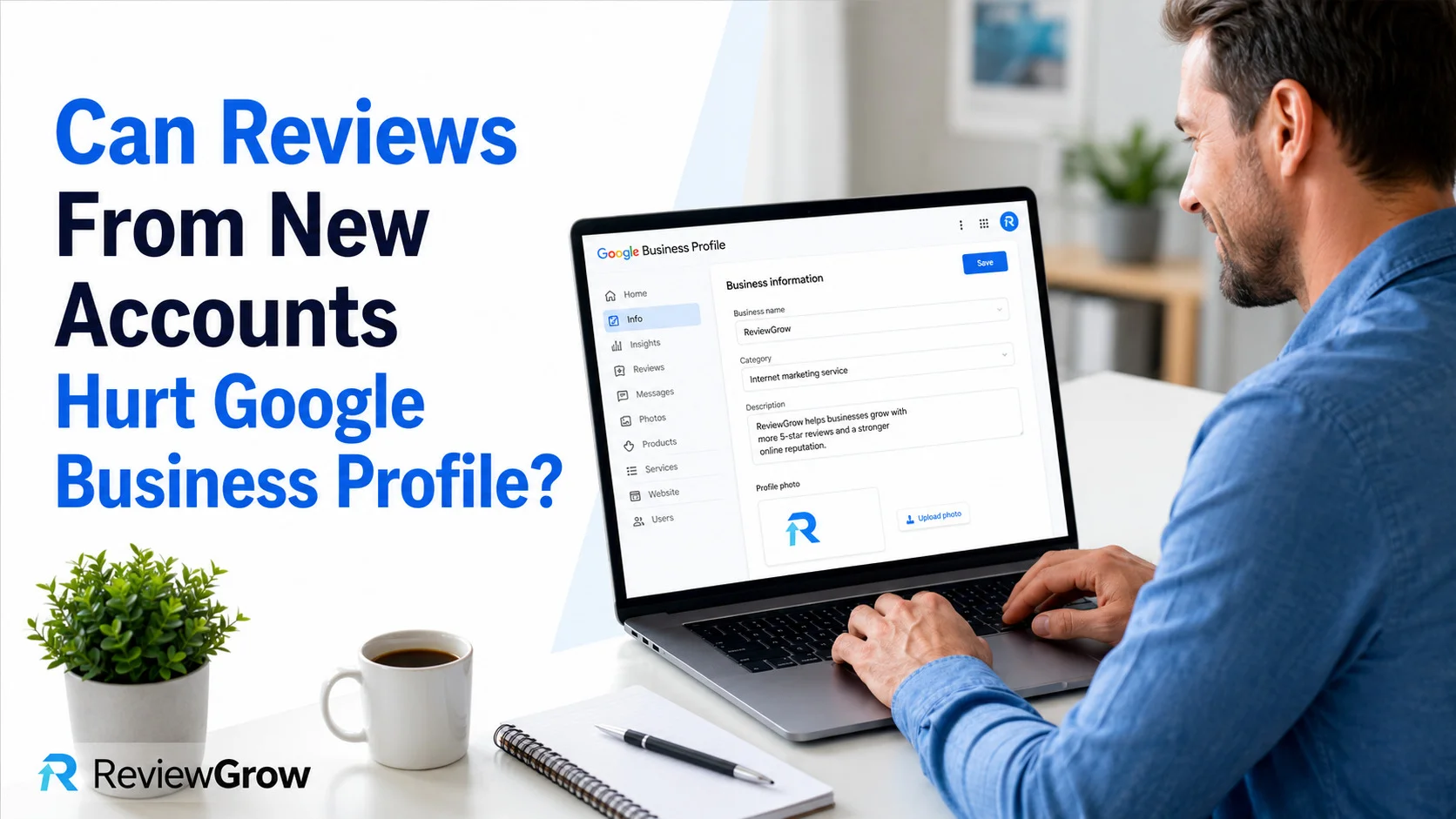
I get this question a lot from business owners who notice a wave of reviews from brand-new Google accounts and start to panic. Here's the direct answer: reviews from new accounts can hurt your Google Business Profile, but only when they look fake, coordinated, incentivized, or abusive. A single genuine review from a first-time Google user is not a problem. The risk comes from the pattern behind the reviews, not the age of the account itself. In this guide, I'll break down exactly when new-account reviews become a real threat, how Google seems to evaluate them, and what to do if your profile gets hit.
The short answer: can reviews from new accounts hurt a Google Business Profile?
No, a review from a brand-new Google account does not automatically hurt your Google Business Profile. I see business owners assume account age alone is a red flag, and that's not accurate. Plenty of real customers only create a Google account the day they decide to leave a review.
That said, reviews from new accounts absolutely can become a problem when they show up in a suspicious pattern. If a batch of reviews looks fake, coordinated, incentivized, or spammy, Google may filter them, your rating can take a hit, or your profile can get flagged for fake engagement.
|
They can hurt your profile if they: • Drag down your star rating with fake 1-star attacks • Trigger review filtering because the pattern looks unnatural • Are part of bought or incentivized review campaigns • Contribute to fake engagement signals tied to your profile |
How Google likely evaluates reviews from new accounts
Google doesn't publish the exact mechanics of its review filtering system, so I want to be upfront that what follows is based on observed patterns, not confirmed algorithm details. From what I've seen across dozens of profiles, Google appears to weigh several trust and spam signals together rather than judging a review by account age alone.
-
Account age is only one signal
A new account isn't automatically suspicious on its own. I've watched plenty of legitimate 5-star and 3-star reviews from same-day accounts stay live indefinitely because nothing else about them looked off.
-
Review patterns matter more than account age alone
What actually seems to raise flags is the combination of signals around the review, not just when the account was created. Here's what tends to draw scrutiny:
• Several reviews posted in a short time window
• Multiple new accounts reviewing the same business
• No profile history or other activity on the account
• Repetitive or templated wording across reviews
• Reviewers with no local footprint or plausible interaction with the business
• Bursts of only 5-star or only 1-star reviews
-
Google may filter reviews before or after they go live
One thing I explain to almost every client: a review can appear to the person who wrote it while never showing up publicly to anyone else. This is one of the most common complaints in local SEO forums and Google's own help threads, and it's usually a sign that Google's spam filter caught something it didn't like.
4 ways reviews from new accounts can hurt your GBP
1) Fake negative reviews can damage your rating and conversions
A handful of fake 1-star reviews from new accounts can drop your visible average rating fast, especially if your total review count is still low. Even if your local rankings don't immediately move, I've seen conversion rates drop right away. People scrolling through Google Maps results skip past lower-rated businesses without a second thought.
2) Suspicious positive reviews can get filtered or removed
This is the one I see backfire the most. A business buys reviews or asks staff and friends to post from freshly created accounts, and those reviews either never stick or get pulled down weeks later. The business thinks it gained social proof, then watches the count quietly drop back down.
3) Manipulative review patterns can create fake-engagement risk
This is bigger than a single review disappearing. When Google detects coordinated, fake, or incentivized review activity, it can treat that as a fake engagement violation tied to the profile itself, not just the individual reviews. That can mean broader enforcement action against the Business Profile.
4) Genuine customer reviews can get caught in the filter too
This is the most frustrating scenario for honest business owners. Some real customers only set up a Google account specifically to leave a review. If several of those arrive close together, Google can mistake the cluster for a suspicious pattern, and valid social proof never makes it to your public profile.
When reviews from new accounts are most likely to look suspicious
Based on what I've tracked across client profiles, these are the patterns most likely to trigger filtering or scrutiny:
• Many reviews arriving in a short time span
• Identical or very similar wording across reviews
• All reviews posted by accounts with no other history
• Multiple reviews from accounts created the same week
• A review spike right after a review-buying campaign
• Reviews from people who were never actual customers
• Reviewers who post one review and never return
• Multiple accounts that appear tied to one person or one campaign
• A sudden burst of 1-star reviews following a dispute or competitor activity
Can fake reviews from new accounts hurt local SEO rankings?
Indirectly, yes. Fake reviews can lower your rating, reduce your click-through rate from Maps and local results, and weaken the trust signals Google associates with your profile. That combination can chip away at visibility over time even without a direct penalty.
Directly, it's possible too, but only if a business is involved in manipulative review practices that violate Google's fake engagement policies. I want to be clear that ordinary review fluctuation is not the same thing as a policy violation.
Reviews are one local trust and prominence signal among many. Rating quality, review velocity, and authenticity carry more weight than raw review volume, and a single fake review from a new account rarely moves rankings on its own.
When can new-account reviews hurt your GBP?
|
Scenario |
Can it hurt your GBP? |
Main risk |
What to do |
|
One real customer leaves a review from a new Google account |
Usually no |
Minimal risk |
No action needed |
|
Several 5-star reviews arrive from brand-new accounts in one day |
Yes, potentially |
Filtering or fake engagement concerns |
Stop campaigns, audit review source |
|
A competitor posts fake 1-star reviews from fresh accounts |
Yes |
Rating damage, reputation harm |
Report, document, respond carefully |
|
Employees or friends leave reviews from newly created accounts |
Yes |
Policy violation, removal risk |
Stop the practice, focus on real customers |
|
Legitimate customers all review at once after a bulk email push |
Sometimes |
Some reviews may be filtered |
Pace requests, avoid unnatural spikes |
Read more: Do Google Reviews Help SEO? Local Ranking Factors Explained
What to do if your business gets fake reviews from new Google accounts
1) Document the pattern
Screenshot everything as soon as you notice it. I recommend capturing the dates, usernames, review text, rating changes, and any similarities between the reviews. This record matters if you need to report the activity or explain the situation later.
2) Report the review through Google Business Profile
Flag the review, select the policy reason that fits best, and monitor the status from your dashboard. This isn't instant, so give it time before assuming nothing happened.
3) Respond publicly if the review stays live
Keep your response calm, factual, and non-accusatory. Make it clear you can't verify the reviewer as a customer based on your records, and invite them to contact the business directly to resolve the issue.
4) Ask real customers for fresh, legitimate reviews
The best long-term defense is dilution through authentic reviews. A steady stream of genuine feedback naturally outweighs a handful of suspicious ones.
5) Avoid buying replacement reviews
Do not fight spam with more spam. Buying reviews to offset fake ones puts your own profile at risk of the exact fake-engagement issues you're trying to escape.
How to ask for Google reviews without triggering suspicion
If you want to build up genuine reviews without accidentally creating a pattern that looks manipulative, keep these practices in mind:
• Ask real customers only
• Ask consistently over time instead of in large bursts
• Don't script every review or hand customers exact wording
• Don't offer incentives in exchange for reviews
• Don't use employees or friends who were never actual customers
• Spread requests across normal post-purchase or post-service touchpoints
• Use a direct review link to make leaving a review easy for customers
Read more: How to Remove Fake Negative Google Reviews (Different Methods)
Final Take
Ultimately, while the occasional review from a new account is a normal part of business, the risk lies in patterns that suggest manipulation. Focus on building genuine, consistent social proof rather than fixating on the age of a reviewer's account. When you prioritize authentic customer experiences, you naturally build a reputation that can weather the occasional spike in suspicious activity.
Yes. A calm, factual response shows future customers how you handle criticism, even if the review itself never gets taken down.
Frequently Asked Questions
Can a brand-new Google account leave a legitimate review?
Yes. Account age alone doesn't make a review invalid. Plenty of real customers create their first Google account specifically to leave feedback.
Why does a Google review show to the reviewer but not publicly?
This usually means Google's spam filter is still evaluating the review or has already filtered it as suspicious. The reviewer sees their own post, but it never appears to anyone else.
Can competitors hurt my GBP with fake 1-star reviews from new accounts?
They can damage your rating and reputation in the short term. Google may remove the reviews if you report them successfully and they violate policy.
Can buying positive reviews from fresh accounts get my GBP in trouble?
Yes. Bought reviews from new accounts often get filtered or removed, and the practice can lead to fake-engagement enforcement against your profile.
Do Google reviews affect local SEO?
Yes, reviews contribute to trust, prominence, and conversion performance in local search. Quality and authenticity matter more than raw volume.
How many fake reviews does it take to hurt my rating?
It depends on your total review count. A business with only 10 reviews will see a much bigger swing from a few fake 1-star reviews than a business with 500 reviews.
Will Google notify me if it filters a suspicious review?
No. Google typically doesn't notify business owners when a review is filtered. You'll usually only notice because the review count doesn't match what a customer told you they posted.
Should I ask new customers to create a Google account just to review me?
You can ask them to leave a review, but don't script the process or push it as a coordinated campaign. Natural, spaced-out requests are far safer than a bulk push.
Can a sudden spike in reviews hurt an otherwise healthy profile?
It can, especially if the spike is all positive or all negative and arrives in a short window. Even legitimate review pushes should be paced out to avoid looking unnatural.
How long does it take Google to remove a reported fake review?
There's no fixed timeline. Some reports resolve within days, while others take weeks or don't get removed at all if Google doesn't find a clear policy violation.
Is it worth responding to a fake review if I don't think it will be removed?
Yes. A calm, factual response shows future customers how you handle criticism, even if the review itself never gets taken down.
Rebecca Stone
Online Reputation ConsultantRebecca Stone is an Online Reputation Consultant who's all about helping people build their brand and win over customers. She loves sharing what she knows, so she writes for the ReviewGrow blog, giving readers the scoop on how to get ahead.