Do Google Reviews Influence Branded Search Rankings?
May 7, 2026
 Rebecca Stone· Online Reputation Consultant
If you have ever wondered whether Google reviews influence branded search rankings, the short answer is yes, both indirectly through trust and engagement signals, and sometimes directly through local SEO algorithms.
Reviews shape how Google perceives your brand as an entity, how users interact with your listing, and how prominently your business appears when someone searches for you by name. The relationship is more layered than most SEO blogs admit, and understanding it can change how you approach reputation, local visibility, and brand search performance.
This guide breaks down exactly how Google reviews connect to branded queries, click-through rates, local prominence, and entity authority, with practical takeaways for businesses and marketers.
What Are Branded Search Rankings?
Branded search rankings refer to how your business performs when someone searches for queries that include your brand name. These are navigational queries, meaning the user already knows who you are and is trying to find you specifically.
Examples of branded searches:
-
"Nike running shoes"
-
"Starbucks near me"
-
"Best dentist Smile Avenue Clinic"
-
"Patagonia return policy"
Branded queries differ from non-branded queries like "running shoes" or "dentist near me," which are discovery-based. With branded searches, Google's job is simpler: surface the most relevant, trustworthy version of the brand the user is looking for. That includes your website, knowledge panel, Google Business Profile, social profiles, and any third-party mentions.
Why does this matter? Because branded search volume is one of the strongest signals of brand authority, and the way Google presents your brand in those results, often heavily influenced by reviews, directly affects perception, click-through rate, and conversions.
Why Google Reviews Are Important for Local Businesses
For local businesses, Google reviews are arguably the single most influential trust asset you can build. They sit at the intersection of marketing, SEO, and customer experience, and they shape decisions long before a customer ever visits your website or storefront.
Here is why they carry so much weight:
-
They drive purchase decisions. BrightLocal's consumer surveys consistently show that more than 90 percent of consumers read online reviews before choosing a local business, and the majority trust them as much as personal recommendations.
-
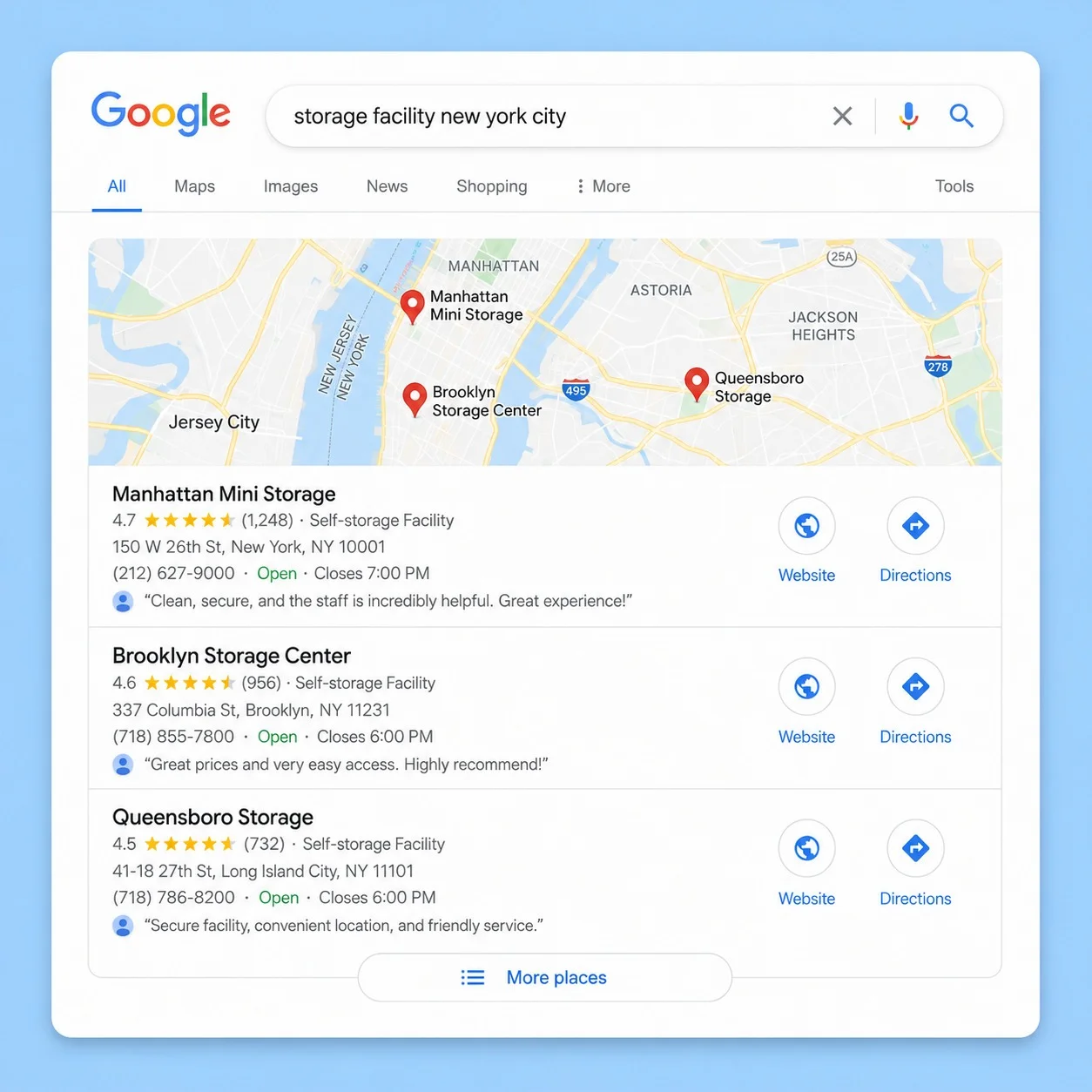
They are visible at the moment of intent. Reviews appear directly in the local pack, Maps, and knowledge panels, exactly when potential customers are deciding whom to call or visit.
-
They feed Google's local algorithm. Reviews influence prominence, one of the three core local ranking pillars.
-
They reduce friction. A strong review profile shortens the consideration cycle and pushes more searchers from "looking" to "buying."
-
They create competitive separation. In crowded local categories like restaurants, dentists, plumbers, or law firms, reviews are often the deciding factor between two otherwise similar businesses.
For a local business, ignoring Google reviews is essentially ignoring your most visible storefront on the internet.
Read more:Why do businesses buy Google reviews?
Are Google Reviews a Ranking Factor?
Yes, Google reviews are an officially acknowledged ranking factor, particularly in local search. Google's own documentation for Google Business Profile states that "high-quality, positive reviews from your customers can improve your business visibility."
Google's local search algorithm relies on three core pillars:
-
Relevance - how well your listing matches the query
-
Distance - how close you are to the searcher
-
Prominence - how well-known and trusted your business is
Reviews fall squarely into the prominence bucket, and they play a meaningful role in relevance too, because review text often contains keywords related to your services.
According to consistent findings from Whitespark's Local Search Ranking Factors survey and BrightLocal's annual local consumer reviews reports, reviews account for roughly 17 to 20 percent of local pack ranking signals. That makes them one of the most influential factors after proximity and Google Business Profile optimization.
So while reviews are not a direct organic ranking factor in the same way backlinks or content quality are, they are a confirmed signal in local search and a powerful indirect influence on branded visibility.
Read more: Do Google reviews help SEO?
How Do Google Reviews Impact Local SEO?
Not all review signals are weighted equally. Google looks at a combination of factors to evaluate your review profile, and each one feeds into your overall local prominence score. Here are the five that matter most.
1. Overall Review Rating
Your average star rating is the most visible review signal, both to users and to Google. Businesses with ratings between 4.2 and 4.9 tend to perform best, because they look credible without appearing artificially perfect. A profile sitting at a flat 5.0 with only a handful of reviews can actually look suspicious. Aim for consistently high ratings backed by enough volume to feel authentic.
2. Volume of Reviews
Quantity matters because it signals real-world engagement and customer activity. A business with 350 reviews looks more established and trusted than one with 18, even if both have similar ratings. More reviews also give Google's algorithm more data to evaluate sentiment, keywords, and reviewer behavior, which strengthens your overall prominence score.
3. Recency of Reviews
Review freshness directly influences how active and relevant your business looks. A profile that earned 200 reviews three years ago but nothing recent tells Google your business may be losing momentum. Steady, recent reviews keep your profile alive in the algorithm's eyes and reinforce that your business is actively serving customers right now.
4. Responding to Reviews
Responses are a confirmed engagement signal. Google explicitly encourages businesses to reply to reviews, and consistent responses suggest active management of your profile. Beyond the SEO benefit, replies improve customer perception, give you a chance to address negative feedback publicly, and let you naturally weave in service-related keywords. A simple rule: respond to every review, positive or negative, within a reasonable window.
5. Quality of Reviews
Quality goes beyond star ratings. Google's NLP systems read review text, evaluating length, detail, sentiment, and the keywords mentioned. A 4-star review that says "great experience, fast service, friendly staff, would recommend for anyone needing emergency dental care" carries far more SEO weight than a 5-star review that just says "good." Encourage customers to share specifics about what they liked, which services they used, and who helped them.
How Google Reviews Influence Branded Search Rankings
This is where most SEO articles stop short. Reviews do not just sit passively on your profile. They actively shape how Google understands your brand as an entity, how users behave on your listing, and how often your brand appears for related queries.
Reviews Improve Local Prominence
Local prominence is essentially Google's way of measuring how known and credible your business is. Review quantity, review quality, review velocity, and review diversity all feed into this signal.
A business with 400 detailed reviews and an average rating of 4.7 stars looks far more authoritative than a competitor with 22 reviews. Google interprets that volume and consistency as real-world validation, which strengthens your overall brand authority and pushes your business higher in local pack rankings and Google Maps results.
Reviews Increase Click-Through Rate
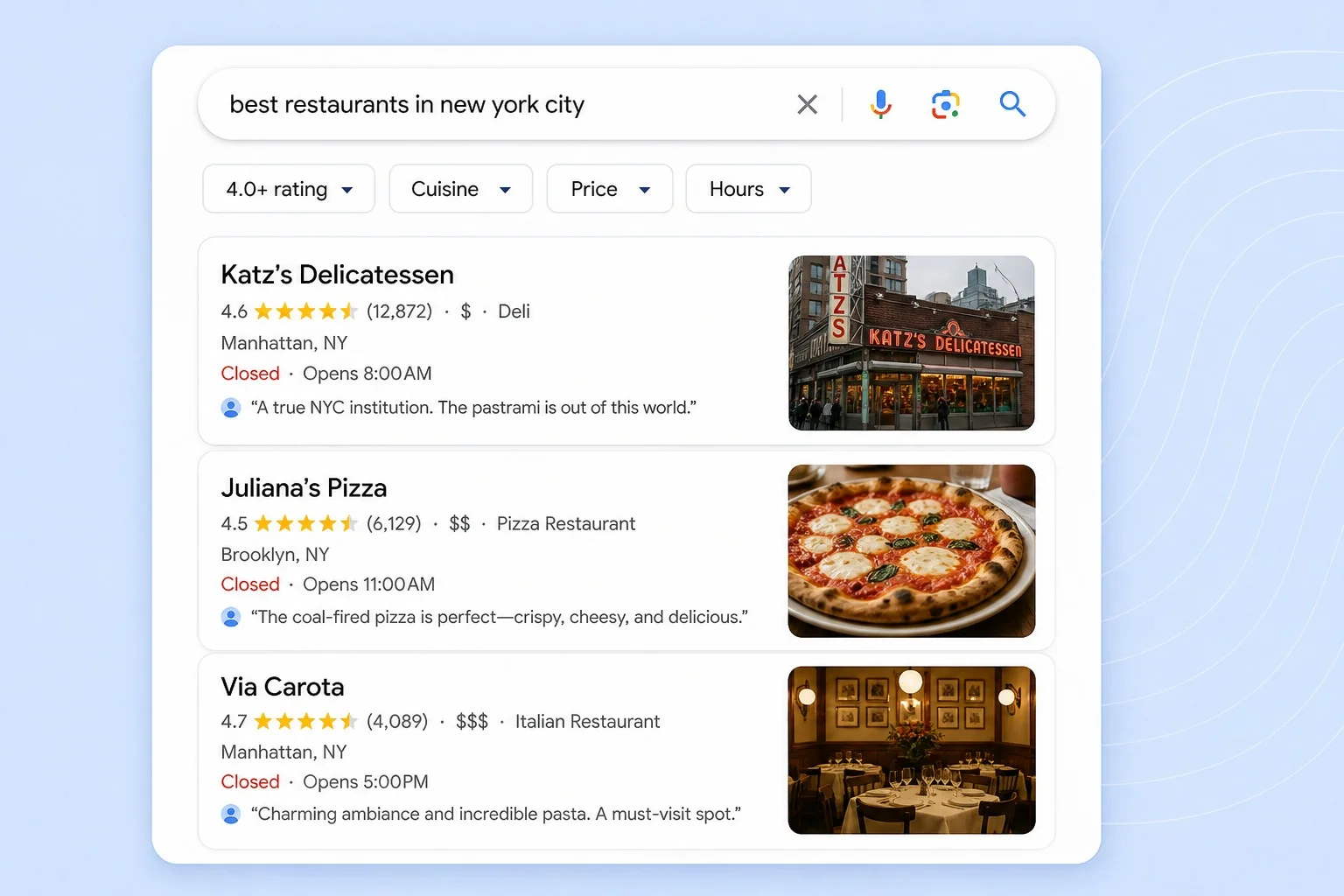
Star ratings appear in search results, knowledge panels, and Maps listings. When users see a 4.8-star rating with hundreds of reviews next to a 3.4-star competitor, the choice is obvious.
Higher CTR matters because Google uses behavioral signals to evaluate result quality. When users consistently click your branded result, spend time on your listing, and convert, that engagement reinforces Google's confidence in displaying your brand prominently. Over time, this creates a positive feedback loop where stronger CTR feeds stronger visibility.
Review Keywords Reinforce Semantic Relevance
This is one of the most overlooked aspects of review-driven SEO. Google's natural language processing reads review text and extracts entities, services, and product mentions.
When customers naturally write things like "best gluten-free bakery in Austin" or "amazing emergency plumbing service at 2 a.m.," they are essentially populating your profile with semantically relevant keywords. Those signals strengthen the connection between your brand and specific services or attributes, which helps you rank for branded queries paired with modifiers (for example, "Acme Bakery vegan options").
This is user-generated content working as semantic SEO, and it is far more authentic than anything you could write yourself.
Review Freshness and Velocity
A steady, consistent flow of new reviews tells Google your business is active, relevant, and trusted in real time. Review freshness, how recent your reviews are, and review velocity, the rate at which you receive them, both influence local prominence.
Dormant profiles with no new reviews in six months can lose ground to competitors who maintain steady momentum. Google rewards businesses that look alive and engaged.
Positive Sentiment Builds Brand Trust
Google uses sentiment analysis to interpret the tone and content of reviews. A profile filled with reviews that mention "professional," "fast," "friendly," and "highly recommend" sends very different signals than one peppered with "rude," "delayed," and "disappointing."
Positive sentiment becomes a reputation signal that strengthens trust at the entity level. This trust then carries into how Google displays your brand across knowledge panels, branded SERPs, and even AI Overviews.
Businesses focused on improving their online reputation can use this Google rating calculator to understand how additional positive reviews affect their overall score.
Google Reviews Have an Impact on SEO Ranking
Beyond the local pack, Google reviews influence broader SEO performance in ways that compound over time. Two effects deserve special attention because they directly shape how your brand performs in search.
Google Reviews Increase Trust
Trust is the currency of modern SEO. Google's systems are built to surface results that users will find credible, and reviews are one of the most direct trust signals available. When your business has hundreds of authentic, recent reviews with strong sentiment, you are essentially showing Google a public, verifiable track record.
That trust extends beyond rankings. It influences:
-
Knowledge panel completeness and prominence
-
Inclusion in AI Overviews and generative search results
-
Brand mentions across third-party sites
-
Higher conversion rates once users do click through
In a search environment increasingly shaped by E-E-A-T and entity authority, reviews function as ongoing, real-world endorsements that algorithms can measure.
Google Reviews Improve Click-Through Rates and Organic Traffic
Star ratings, review counts, and snippet-rich review content all influence how your listings look in the SERP, and that visual difference translates directly into clicks. Listings with prominent star ratings consistently earn higher CTR than plain results, even when ranked in similar positions.
Higher CTR drives a chain reaction:
-
More clicks mean more sessions and more potential conversions
-
Stronger engagement reinforces Google's confidence in your result
-
Increased branded search volume follows, as satisfied customers search for you again
-
Organic traffic grows even on non-branded queries because your overall authority improves
In other words, reviews do not just help you rank. They help you actually capture the traffic that ranking unlocks.
Do Reviews Directly Affect Organic Rankings or Only Local SEO?
This is the nuance most articles miss.
Local SEO and Maps: Reviews have a direct, measurable effect. They influence local pack rankings, Maps visibility, and the local prominence score. If you operate any business with a physical location or service area, reviews directly impact where you appear.
Organic search: The effect is indirect but real. Reviews influence:
-
CTR on branded results
-
Time on site and engagement
-
Branded search volume (happy customers search for you again)
-
Trust signals that reinforce E-E-A-T
-
Knowledge panel completeness and accuracy
So if someone tells you "reviews don't affect organic rankings," they are technically correct in a narrow sense, but missing the bigger picture. Reviews shape behavioral and trust signals that Google increasingly relies on for ranking decisions, especially for branded queries.
Can Negative Reviews Hurt Branded Visibility?
Negative reviews can absolutely hurt your branded visibility, though usually not through a direct ranking penalty.
Here is what actually happens:
-
Lower CTR: A 3.1-star rating next to your branded result discourages clicks, weakening engagement signals over time.
-
Reputation damage: Users who search your brand and see negative sentiment may abandon the journey or choose a competitor.
-
Trust decline: Sentiment analysis reads the negative language patterns, which can erode entity trust.
-
Lost conversions: Even if rankings hold, the business outcome suffers.
That said, a few negative reviews are not catastrophic. Google understands that no business is perfect, and a profile with all 5-star reviews can actually look suspicious. The key is responding professionally, addressing issues, and maintaining a healthy overall sentiment.
Google Reviews and E-E-A-T
Google's E-E-A-T framework, Experience, Expertise, Authoritativeness, and Trustworthiness, was designed to reward content and entities that demonstrate real-world credibility. Reviews are one of the clearest signals of all four.
-
Experience: Reviews are written by real customers describing actual experiences with your business.
-
Expertise: Detailed reviews often validate the expertise of your team or product quality.
-
Authoritativeness: Volume, recency, and sentiment establish your brand as a recognized entity in your category.
-
Trustworthiness: Transparent, public feedback from real users is one of the most powerful trust signals available.
This is why review-rich businesses tend to dominate branded SERPs and earn richer knowledge panel features. Reviews are essentially user-validated proof that your business exists, performs, and matters.
Best Practices for Improving Rankings With Reviews
If you want reviews to actively support your branded search performance, focus on quality, consistency, and authenticity.
1. Request reviews consistently. Build review collection into your customer journey. Send follow-up emails, SMS reminders, or QR codes at point of service. Consistency matters more than bursts.
2. Never use fake reviews. Google detects and penalizes fake reviews, and the reputational damage from getting caught is severe. Beyond Google's policies, FTC regulations also prohibit deceptive testimonials.
3. Respond to every review. Responses signal engagement and are believed to influence local rankings. Reply professionally to both positive and negative reviews.
4. Encourage detailed reviews. Ask customers to mention specific services, products, or staff members. This naturally injects review keywords that strengthen semantic relevance.
5. Maintain steady review velocity. A predictable flow of new reviews keeps your profile fresh and signals ongoing customer activity to Google's algorithm.
6. Optimize your Google Business Profile. Reviews work best when paired with a complete, well-optimized Google Business Profile. Categories, attributes, photos, posts, and Q&A all reinforce the signals reviews send.
7. Diversify review sources. While Google reviews matter most for Google rankings, reviews on Yelp, BBB, industry-specific platforms, and social media also strengthen your overall entity trust.
Common Myths About Google Reviews and SEO
Myth 1: More reviews automatically guarantee higher rankings. False. A business with 1,000 generic reviews will not necessarily outrank a competitor with 200 detailed, recent, well-distributed reviews. Quality, freshness, and sentiment matter as much as quantity.
Myth 2: Only star ratings matter. False. Review text, keywords, length, recency, and reviewer credibility all factor in. Google reads the content, not just the score.
Myth 3: Negative reviews destroy SEO. False. A handful of negative reviews can actually add credibility. What hurts is a pattern of negative sentiment paired with no responses or improvements.
Myth 4: Reviews only matter for local businesses. Partly false. Local businesses see the strongest direct impact, but national brands and ecommerce businesses also benefit from reviews through CTR, branded search trust, and knowledge panel reinforcement.
Myth 5: You can buy reviews safely. False. Buying reviews violates Google's policies and FTC guidelines, and detection is increasingly sophisticated.
Final Verdict
Do Google reviews influence branded search rankings? Yes, decisively, and the influence runs deeper than most SEO discussions acknowledge.
The strongest direct effect shows up in local SEO, Google Maps, and the local pack, where reviews are a confirmed prominence signal. The indirect effects show up everywhere else: stronger CTR on branded queries, richer entity signals, better knowledge panel presentation, improved trust, and stronger E-E-A-T validation.
The businesses that win branded search visibility are not the ones with the most reviews. They are the ones with consistent, recent, detailed, positive reviews, paired with thoughtful responses and an optimized Google Business Profile. Trust and engagement outweigh raw review count every time.
If you want to own your branded SERP, treat reviews as a long-term asset, not a one-time campaign. The compounding effect on visibility, conversions, and brand authority is too significant to ignore.
Frequently Asked Questions
Do Google reviews help SEO?
Yes. Google reviews directly influence local SEO rankings and indirectly improve organic visibility through CTR, trust signals, and branded search behavior.
Are Google reviews a ranking factor?
Yes, Google has officially confirmed that reviews influence local search rankings. Studies estimate they contribute around 17 to 20 percent of local pack ranking signals.
Can bad reviews hurt rankings?
Bad reviews rarely cause direct ranking penalties, but they can lower CTR, erode trust, and weaken behavioral signals, all of which can indirectly harm visibility.
How many Google reviews do I need?
There is no fixed number. Aim to match or exceed your top local competitors, and prioritize a steady flow of recent, detailed reviews over hitting a specific count.
Does responding to reviews help SEO?
Yes. Responding signals engagement, builds trust, and is widely believed to influence local rankings. It also gives you an opportunity to naturally include relevant keywords in your replies.
Do reviews affect Google Maps rankings?
Absolutely. Reviews are one of the strongest signals in Google Maps and local pack rankings, alongside proximity and Google Business Profile optimization.
What matters more: review quality or quantity?
Both matter, but quality wins long-term. A profile with detailed, recent, positive reviews and steady velocity will outperform a profile with high volume but stale or generic content.
Rebecca Stone
Online Reputation ConsultantRebecca Stone is an Online Reputation Consultant who's all about helping people build their brand and win over customers. She loves sharing what she knows, so she writes for the ReviewGrow blog, giving readers the scoop on how to get ahead.